
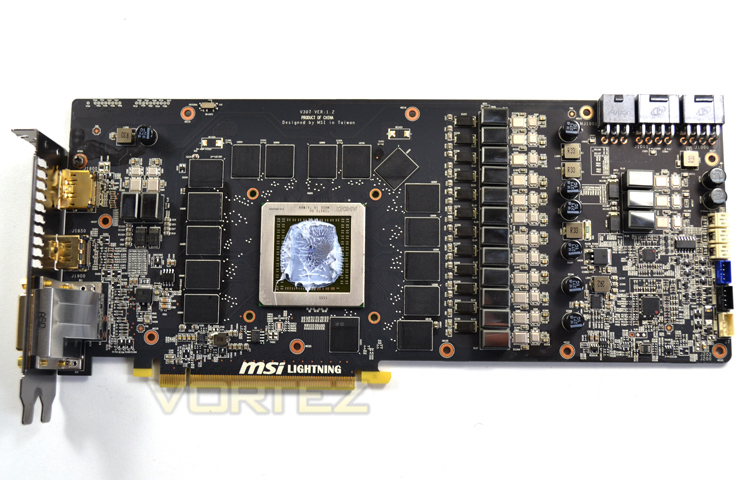
The PCB is a custom design featuring MSI's Military Class 4 Components. The PCB is positively crammed with components designed to take some serious abuse, not only from overclocking as you would expect but hot plugging a DVI monitor which in itself can produce an Electical Static Discharge (ESD), enough to damage traces rendering the card useless. MSI call this Transient Voltage Suppression but whatever its official title, it is a welcome addition as anything that protects against the dreaded ESD.
The layout is however familiar with the main voltage regulation module found closest to the power ports with the main exposed GPU framed with memory chips.

The power delivery system is made up of a 10+3+2 power phase design, 10 for the GPU, 3 for the memory with 2 power phases reserved for the PLL. That is quite an impressive setup which thankfully rids the unsightly and bulky GPU core reactor we saw on the back of the HD7970 Lightning. The power design features only the very best components included Hi-C caps, CopperMOS, Dark Solid Capacitors and new Super Ferrite Chokes which equate to enhanced durability and overclocking.


The 3 memory phases take power jointly from the added PCIe power cables while the PLL of the card takes its power from the PCIe clot. Having this type of setup means the motherboard is not adversely stressed and theoretically will enhance system stability, especially during overclocking scenarios.

Power is nothing without control so we are told and above is just one of the three PWM controllers used on the card. This is a shift away from the reference design which had just one controller for the whole card.

There are generally 3 choices for memory when building a graphics card. Elpida is generally regarded as bottom of the pile where overclocking is concerned while SK Hynix is a cut above. The very best chips hail from Samsung though and this is what we have on the R9 290X Lightning.

Even the core is hand picked by MSIs testing engineers for guaranteed stable overclocking. Each core has to complete a 24hr burn-in test before being speed binned for the 290X lightning.
All in all, what we have here is the very best in cooling, power delivery, looks and packaging. the only thing left to look at is the actual performance of the card. We think it's time we found out...


