
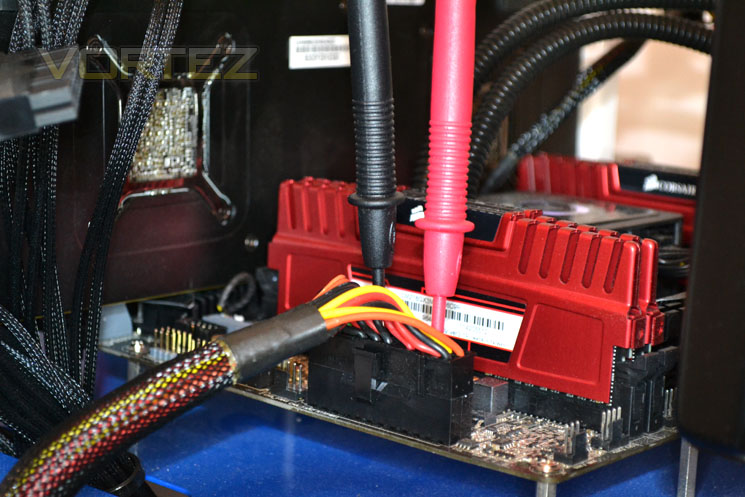
Our testing methodology for testing Power Supply Units is limited to the multi-meter to show each rails performance due to us not having access to an ATE load tester. We are making plans to invest in equipment as we were directed by Cooler Master when Simon visited their test labs in June 2010.
Although this does constrain us slightly we can still monitor fluctuations on the rails and give the unit a good assessment when we feature it in one of our builds. The way the testing will run is simple, voltages will be observed at idle wattage and then a single GPU will be installed within the system and a combination of Prime95 and MSI Kombustor will be executed to provide simulation with just 1 GPU. This will be run for 20 minutes. The CPU will also be overclocked to 4.5GHz to maximise power consumption and strain. This should give us a good indication of how the Corsair TX750M will perform under gaming stresses and beyond.
Power Supply – Corsair TX750M 750W
Motherboard: ASRock Extreme4-M X79
CPU: Intel Core i7-3960X Extreme Edition
Graphics Card: NVIDIA GTX560Ti
RAM - 16GB (4x4GB) Corsair Vengeance (Red) DDR3 @ 1866MHz 9-10-9-27
Hard Drive – Hitachi SATA II 250GB
Samsung F3 1TB
Cooler – Corsair H100
I deliberately chose the HD6990 as being a dual core GPU it was the most power hungry card we have ever had at Vortez. AMD actually recommend a 700W PSU for this graphics card so it will be a close run thing. Hopefully the Corsair power protection will kick in long before we destroy the test rig should the power draw become too much although going by past experience, GPU manufacturers do exaggerate the PSU requirements somewhat.
For voltage tolerance levels, ATX specify that a 5% variable fluctuation is acceptable. (Form Factors - ATX Specification PDF - Page 10). So what this means is:
3.3V Rail - 3.135V - 3.465V acceptable
5V Rail - 4.75V – 5.25V acceptable
12V Rail - 11.4V – 12.6V acceptable
Idle test - The system settles in windows without any applications or stressing
Combined load - Prime95 + MSI Kombuster simultaneously
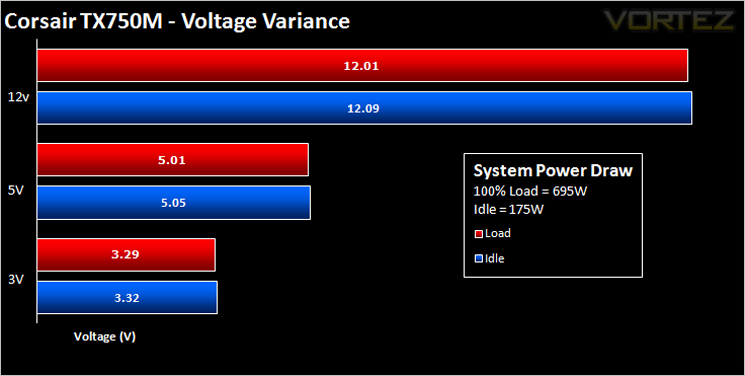
As you can see from the image above, at both idle and load all the lines were well within ATX specification and only drooped ever so slightly under 92.6% (695W from the wall) load. Using a multimeter to measure the voltage is quite obviously not the most efficient manner in which to thoroughly measure a PSU's capability but I believe we have given a true reflection of its 'real-life' capability today.
Let's move on to the conclusion where the Corsair TX750M receives both criticism and praise in equal amounts...
Although this does constrain us slightly we can still monitor fluctuations on the rails and give the unit a good assessment when we feature it in one of our builds. The way the testing will run is simple, voltages will be observed at idle wattage and then a single GPU will be installed within the system and a combination of Prime95 and MSI Kombustor will be executed to provide simulation with just 1 GPU. This will be run for 20 minutes. The CPU will also be overclocked to 4.5GHz to maximise power consumption and strain. This should give us a good indication of how the Corsair TX750M will perform under gaming stresses and beyond.
Power Supply – Corsair TX750M 750W
Motherboard: ASRock Extreme4-M X79
CPU: Intel Core i7-3960X Extreme Edition
Graphics Card: NVIDIA GTX560Ti
RAM - 16GB (4x4GB) Corsair Vengeance (Red) DDR3 @ 1866MHz 9-10-9-27
Hard Drive – Hitachi SATA II 250GB
Samsung F3 1TB
Cooler – Corsair H100
I deliberately chose the HD6990 as being a dual core GPU it was the most power hungry card we have ever had at Vortez. AMD actually recommend a 700W PSU for this graphics card so it will be a close run thing. Hopefully the Corsair power protection will kick in long before we destroy the test rig should the power draw become too much although going by past experience, GPU manufacturers do exaggerate the PSU requirements somewhat.
For voltage tolerance levels, ATX specify that a 5% variable fluctuation is acceptable. (Form Factors - ATX Specification PDF - Page 10). So what this means is:
3.3V Rail - 3.135V - 3.465V acceptable
5V Rail - 4.75V – 5.25V acceptable
12V Rail - 11.4V – 12.6V acceptable
Idle test - The system settles in windows without any applications or stressing
Combined load - Prime95 + MSI Kombuster simultaneously
As you can see from the image above, at both idle and load all the lines were well within ATX specification and only drooped ever so slightly under 92.6% (695W from the wall) load. Using a multimeter to measure the voltage is quite obviously not the most efficient manner in which to thoroughly measure a PSU's capability but I believe we have given a true reflection of its 'real-life' capability today.
Let's move on to the conclusion where the Corsair TX750M receives both criticism and praise in equal amounts...


