
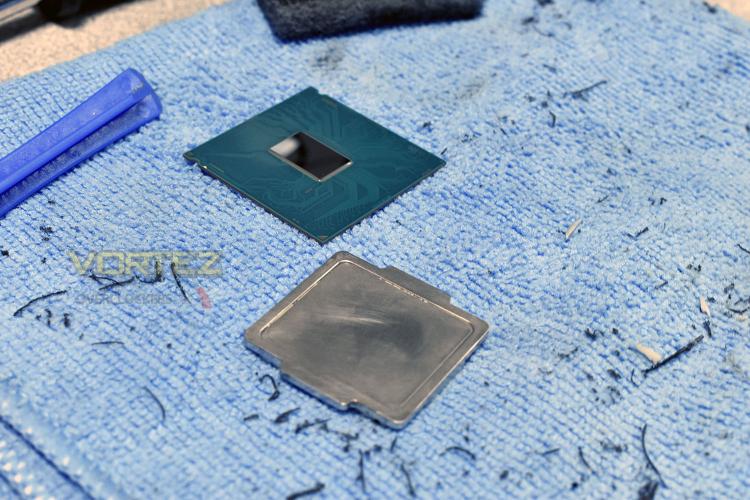
A CPU is essentially made up of 3 fundamental parts, the PCB, onto which everything is mounted, the core, where the silicon is hidden, and the IHS, the large copper heatsink, designed to protect the core from damage as well as distribute the huge amounts of heat generated underneath.
De-lidding a processor involves breaking the gasket seal between the CPUs PCB and the IHS, giving clear access to the core, allowing you to replace the manufacturer’s pre-applied Thermal Interface Material. Removing the IHS gives two clear advantages; firstly, the distance between the IHS and the CPU is smaller, due to the removal of the gasket around the IHS, immediately resulting in better temperatures. Secondly, the Thermal Interface Material is replaced with Thermal Grizzly Conductonaut, a much more effective interface between the copper IHS and the CPU core, allowing the heat to dissipate more efficiently. Some hardcore enthusiasts go as far as leaving the IHS off the chip and instead apply their heatsink directly to the core, removing a barrier where heat transfer can be slowed.
When overclocking, extra voltage is often required to increase stability at higher frequencies. This extra voltage is your worst enemy in terms of heat generated, sometimes sending temperatures skyward rapidly. Increasing the thermal efficiency of your CPUs IHS gives your heatsink the best possible chance of keeping everything cool and in order; if the heat from the CPU isn’t efficiently transferred away, your overclocking headroom will be severely hindered.
We took along an Intel Core i7-7700K CPU from our office, a CPU which was regularly hitting 90°C during stress testing; we were obviously keen to reduce these temperatures to a more manageable level.
De-lidding a processor involves breaking the gasket seal between the CPUs PCB and the IHS, giving clear access to the core, allowing you to replace the manufacturer’s pre-applied Thermal Interface Material. Removing the IHS gives two clear advantages; firstly, the distance between the IHS and the CPU is smaller, due to the removal of the gasket around the IHS, immediately resulting in better temperatures. Secondly, the Thermal Interface Material is replaced with Thermal Grizzly Conductonaut, a much more effective interface between the copper IHS and the CPU core, allowing the heat to dissipate more efficiently. Some hardcore enthusiasts go as far as leaving the IHS off the chip and instead apply their heatsink directly to the core, removing a barrier where heat transfer can be slowed.
When overclocking, extra voltage is often required to increase stability at higher frequencies. This extra voltage is your worst enemy in terms of heat generated, sometimes sending temperatures skyward rapidly. Increasing the thermal efficiency of your CPUs IHS gives your heatsink the best possible chance of keeping everything cool and in order; if the heat from the CPU isn’t efficiently transferred away, your overclocking headroom will be severely hindered.
We took along an Intel Core i7-7700K CPU from our office, a CPU which was regularly hitting 90°C during stress testing; we were obviously keen to reduce these temperatures to a more manageable level.


