
Testing
We are using an ElmorLabs PMD2 that monitors and measures voltage, current, and power flowing through the CPU, GPU and motherboard power cables.
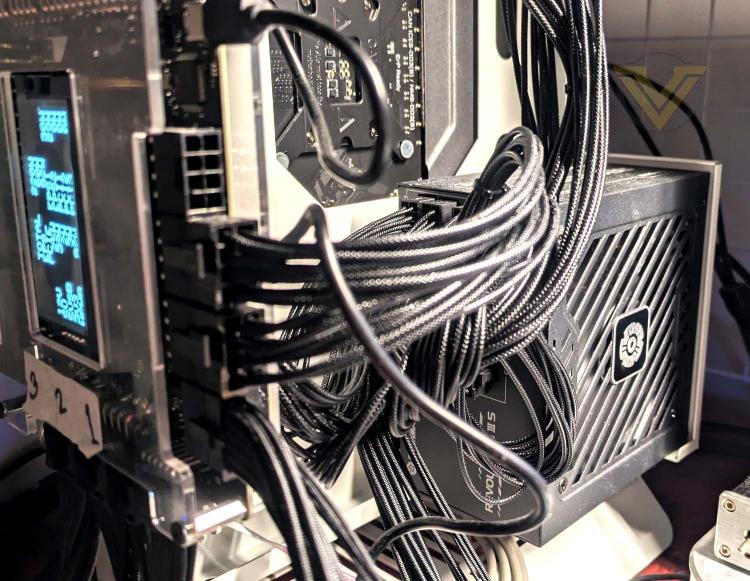
Our testing methodology uses OCBase’s OCCT Enterprise Edition software for power loading and monitoring. Tweaking the OCCT Stability Test, we can set different power loads for the PSU easier rather than playing around with various software to achieve set power loads. All testing is conducted using the 230V residential power standard.

Methodology
Using the ElmorLabs PMD2, we have couple of testing points which will now include the 12V-2x6 connector given the 12V-2x6 to PCIe cable provided by the REVOLUTION III S 1000W. In PMD2, the 12V-2x6 connector is labelled as “HPWR”. The 12V-2x6 connector splits to two PCIe 8pin connectors which will power our RTX 3070 graphics card. The PSU also supplied two PCIe 8-pin connectors, one will power the RTX 4060 Ti. The other PCIe 8pin will remain plugged to the PMD2 will still read voltages despite not supplying power to any component. We will still get the +5V and +3.3V readings using PMD2.
The PMD2 cannot monitor the +12V on the SATA/MOLEX power cables. For that, we will still be using a multimeter to also monitor the voltages delivered to the SATA/MOLEX cables.
Power load will be at approximately 10% increments using the OCCT Stability Test running for 5 minutes – as much as our current testing setup allows which is currently 750W~800W with the following testing configuration below:
Results
The recorded voltages represent the average readings taken during each 5-minute power-load run using the OCCT Stability Test.
OCCT Stability Tests
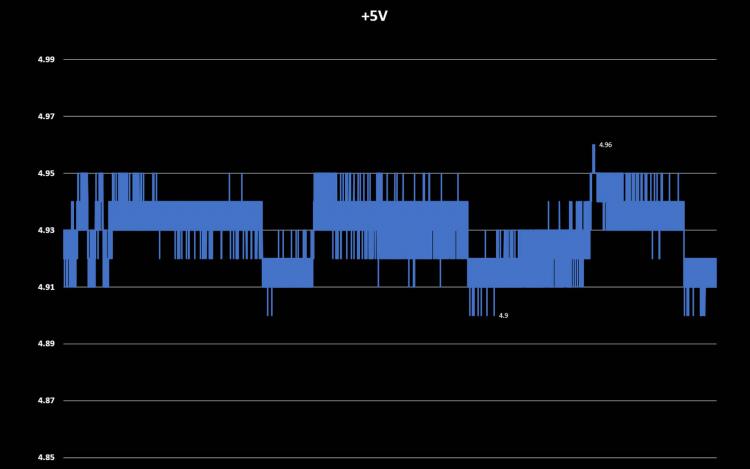
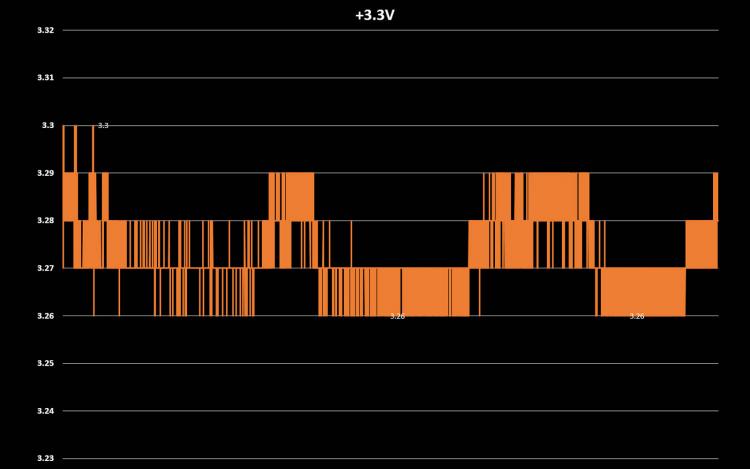
The graphs below are readings during the 60%, 70%, and maximum load tests.
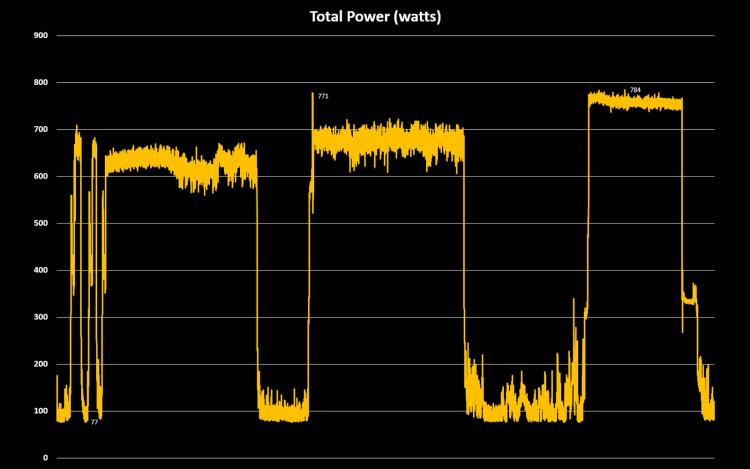
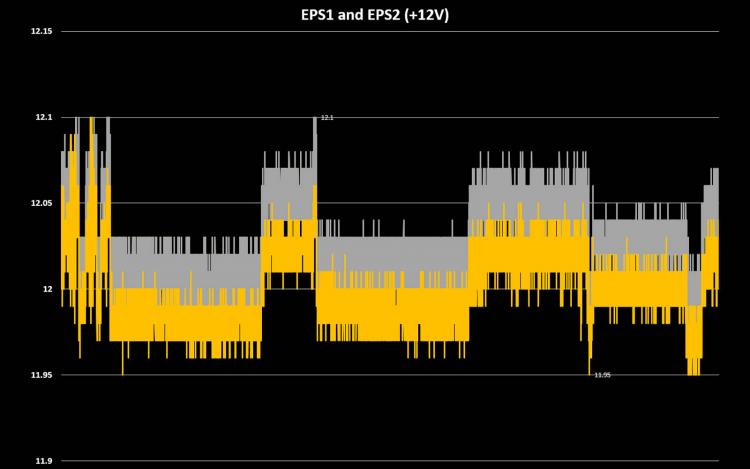
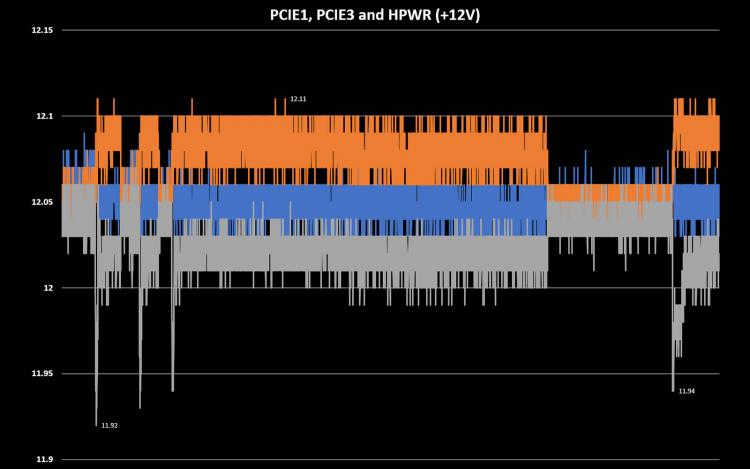
Our REVOLUTION III S 1000W sample demonstrated excellent +12V voltage regulation across all primary output rails, including the PCIe, native 12V-2x6, and EPS connectors, with deviations remaining comfortably below 1% across the tested load range. This level of control is particularly commendable and aligns with expectations for a Platinum-rated, ATX 3.1-compliant power supply.
The +12V output on the SATA/Molex rail exhibited slightly wider variance by comparison, though still within acceptable limits and well inside ATX specifications. Given that this rail typically powers lower-demand peripherals such as storage devices, controllers, and accessories, the observed behaviour is unlikely to have any practical impact on system stability or performance.
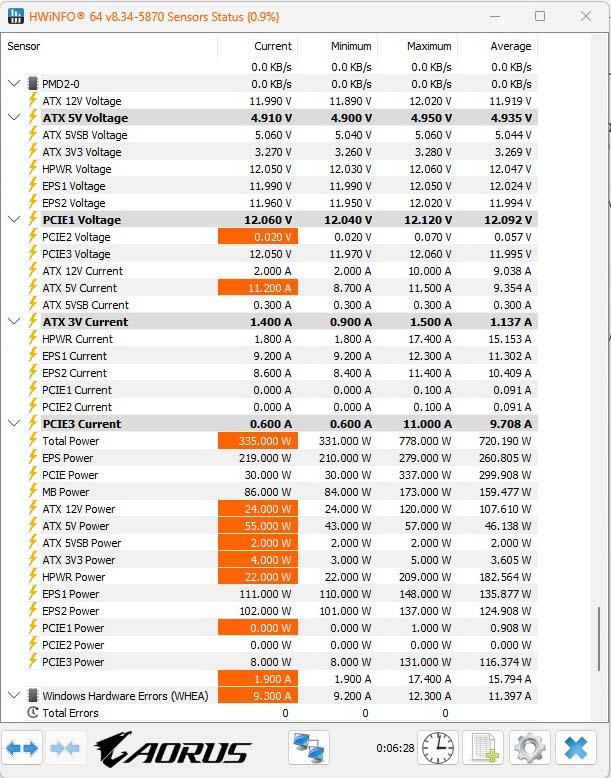
Voltage regulation on the ATX +5V rail exceeded the 1% mark and remained consistently below the nominal 5.0V level throughout testing. While this is less tight than the +12V rails, it remains within specification and is not unexpected, as modern platforms place far less electrical stress on the +5V rail compared to earlier system designs.
The strong voltage regulation observed on the +12V rails is particularly important, as these outputs directly supply power to the system’s most critical components — namely the CPU via the EPS connectors, and the graphics card via PCIe and 12V-2x6 interfaces. Tight regulation in these areas helps ensure stable operation under rapid load changes, reduces electrical stress on downstream components such as VRMs, and contributes to improved reliability and longevity, especially in high-performance systems with power-hungry CPUs and GPUs.
Acoustics
The REVOLUTION III S incorporates a semi-fanless cooling mode, where the internal fan remains inactive below approximately 60% load, provided the unit does not exceed its thermal threshold. According to ENERMAX, fan activation is also influenced by internal temperature, with the fan engaging at around 45°C, which is a relatively conservative trigger point. Compared to the standard REVOLUTION III, the REVOLUTION III S is also equipped with a quieter fan design.
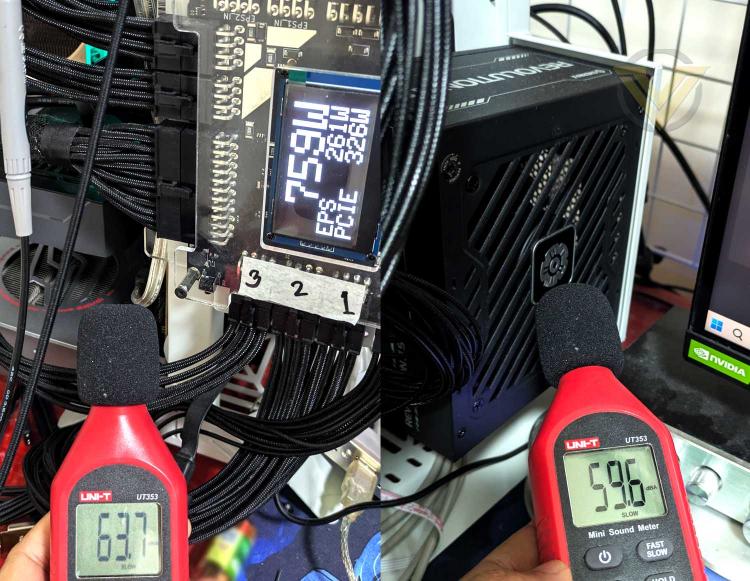
Under higher system loads, overall noise output is dominated by the graphics card and CPU cooling solution rather than the power supply itself. The PSU carries a Cybenetics Standard++ noise rating, reflecting its restrained acoustic profile. Combined with the semi-passive cooling behaviour, the REVOLUTION III S delivers silent operation during low-load scenarios.
We are using an ElmorLabs PMD2 that monitors and measures voltage, current, and power flowing through the CPU, GPU and motherboard power cables.
Our testing methodology uses OCBase’s OCCT Enterprise Edition software for power loading and monitoring. Tweaking the OCCT Stability Test, we can set different power loads for the PSU easier rather than playing around with various software to achieve set power loads. All testing is conducted using the 230V residential power standard.
Methodology
Using the ElmorLabs PMD2, we have couple of testing points which will now include the 12V-2x6 connector given the 12V-2x6 to PCIe cable provided by the REVOLUTION III S 1000W. In PMD2, the 12V-2x6 connector is labelled as “HPWR”. The 12V-2x6 connector splits to two PCIe 8pin connectors which will power our RTX 3070 graphics card. The PSU also supplied two PCIe 8-pin connectors, one will power the RTX 4060 Ti. The other PCIe 8pin will remain plugged to the PMD2 will still read voltages despite not supplying power to any component. We will still get the +5V and +3.3V readings using PMD2.
The PMD2 cannot monitor the +12V on the SATA/MOLEX power cables. For that, we will still be using a multimeter to also monitor the voltages delivered to the SATA/MOLEX cables.
Power load will be at approximately 10% increments using the OCCT Stability Test running for 5 minutes – as much as our current testing setup allows which is currently 750W~800W with the following testing configuration below:
CPU: Intel Core i7-13700K (5.3GHz)
Cooling: Noctua NH-D15 G2
Motherboard: GIGABYTE Z790 AORUS EXTREME X
Graphics Card: GIGABYTE GeForce RTX 3070 EAGLE OC / COLORFUL iGame GeForce RTX 4060 Ti
Memory: ADATA XPG Lancer DDR5-8000 32GB Kit
Storage: ADATA Legend 960 Max 1TB / 2TB Seagate SkyHawk 5900 RPM
PSU: ENERMAX REVOLUTION III S 1000W
Cooling: Noctua NH-D15 G2
Motherboard: GIGABYTE Z790 AORUS EXTREME X
Graphics Card: GIGABYTE GeForce RTX 3070 EAGLE OC / COLORFUL iGame GeForce RTX 4060 Ti
Memory: ADATA XPG Lancer DDR5-8000 32GB Kit
Storage: ADATA Legend 960 Max 1TB / 2TB Seagate SkyHawk 5900 RPM
PSU: ENERMAX REVOLUTION III S 1000W
Results
The recorded voltages represent the average readings taken during each 5-minute power-load run using the OCCT Stability Test.
Voltages
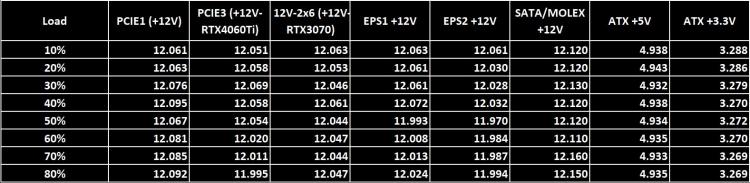
Voltage Regulation
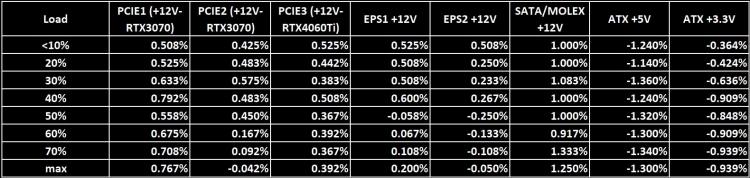
Voltage Regulation
OCCT Stability Tests
The graphs below are readings during the 60%, 70%, and maximum load tests.
Our REVOLUTION III S 1000W sample demonstrated excellent +12V voltage regulation across all primary output rails, including the PCIe, native 12V-2x6, and EPS connectors, with deviations remaining comfortably below 1% across the tested load range. This level of control is particularly commendable and aligns with expectations for a Platinum-rated, ATX 3.1-compliant power supply.
The +12V output on the SATA/Molex rail exhibited slightly wider variance by comparison, though still within acceptable limits and well inside ATX specifications. Given that this rail typically powers lower-demand peripherals such as storage devices, controllers, and accessories, the observed behaviour is unlikely to have any practical impact on system stability or performance.
Voltage regulation on the ATX +5V rail exceeded the 1% mark and remained consistently below the nominal 5.0V level throughout testing. While this is less tight than the +12V rails, it remains within specification and is not unexpected, as modern platforms place far less electrical stress on the +5V rail compared to earlier system designs.
The strong voltage regulation observed on the +12V rails is particularly important, as these outputs directly supply power to the system’s most critical components — namely the CPU via the EPS connectors, and the graphics card via PCIe and 12V-2x6 interfaces. Tight regulation in these areas helps ensure stable operation under rapid load changes, reduces electrical stress on downstream components such as VRMs, and contributes to improved reliability and longevity, especially in high-performance systems with power-hungry CPUs and GPUs.
Acoustics
The REVOLUTION III S incorporates a semi-fanless cooling mode, where the internal fan remains inactive below approximately 60% load, provided the unit does not exceed its thermal threshold. According to ENERMAX, fan activation is also influenced by internal temperature, with the fan engaging at around 45°C, which is a relatively conservative trigger point. Compared to the standard REVOLUTION III, the REVOLUTION III S is also equipped with a quieter fan design.
Under higher system loads, overall noise output is dominated by the graphics card and CPU cooling solution rather than the power supply itself. The PSU carries a Cybenetics Standard++ noise rating, reflecting its restrained acoustic profile. Combined with the semi-passive cooling behaviour, the REVOLUTION III S delivers silent operation during low-load scenarios.


