
Power Consumption
To test for power consumption we do not use anything too technical, just a wall meter which measures the total system power draw minus the monitor.
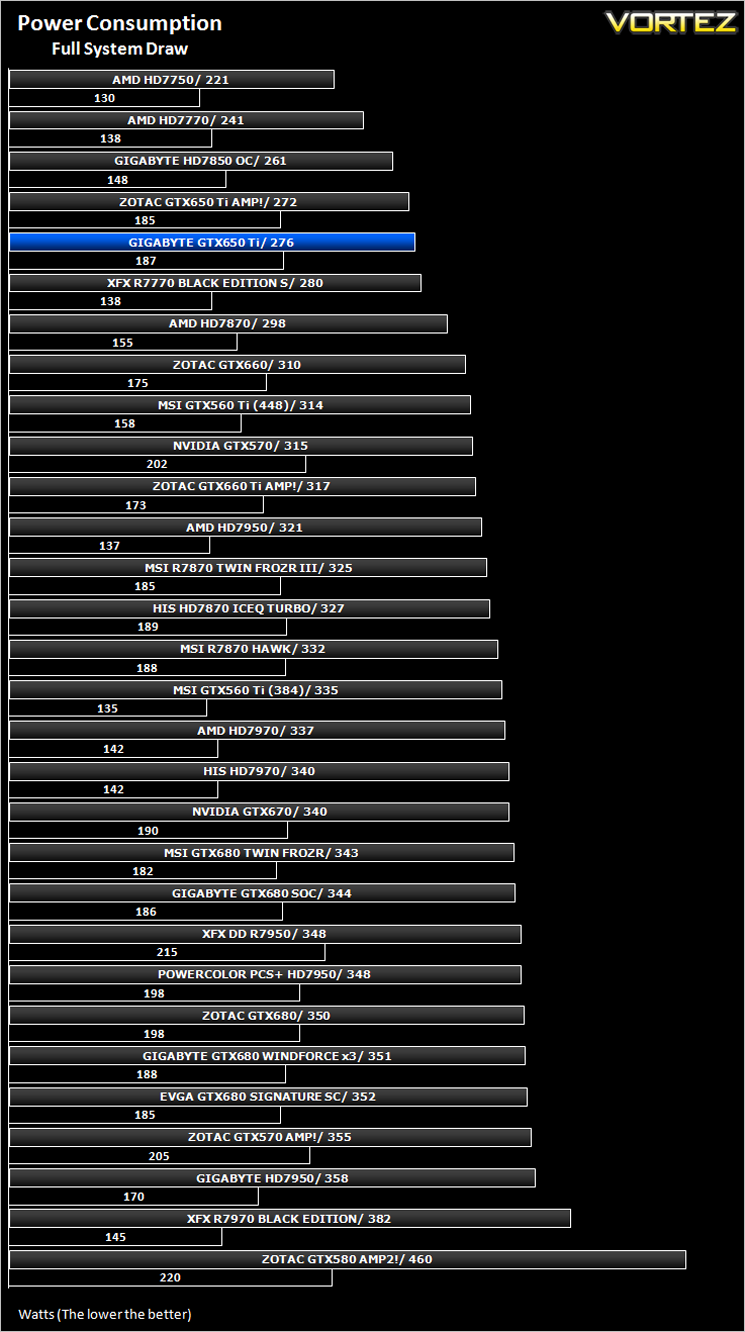
A 400w power supply with a single 6pin PCIe power cable is all that's required to power the GTX65 0Ti and as you can see from the graph above, low power consumption is one of the GTX650 Ti's main attractions. That said in could not quite match the AMD HD7770, consuming around 30W more under load and just a tiny bit more than the ZOTAC GTX650 Ti perhaps due to the additional fan used on the GIGABYTE variant.
Temperature
To test temperatures we measured idle temperatures after booting windows, letting all applications finish loading and ran a few benchmarks. Once the benchmarks were complete we left the card to reach a cooling plateau where we then took the idle temperatures. For the load tests, we would normally run Furmark for 20 minutes, taking the absolute maximum temperature attained however we found that this throttled the card and resulted in spurious results. So we set Heaven running continuously for 20 minutes and used this as a temperature result as the card did not throttle with this application.
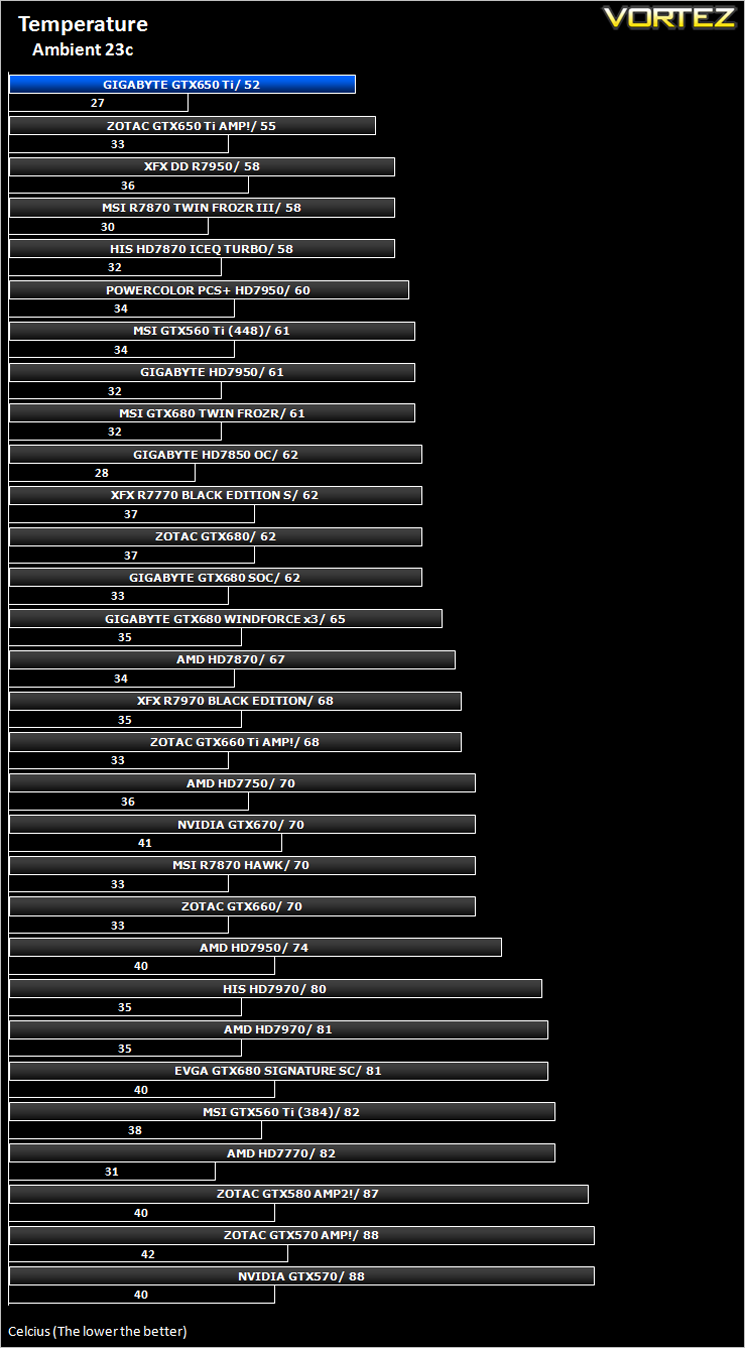
WOW! The GIGABYTE Windforce cooler managed to top our cooling charts making an already cool running card much cooler. Sadly this additional cooling power is wasted due to the fact the GTX650 Ti's overclocking is locked. That said there are still benefits to be had from a cool running GPU. Lifespan for one and silence for another because the hotter a card runs, the faster the fans will spin and faster fans usually equates to an increase in volume.
Acoustics
The GIGABYTE GTX650 Ti, thanks in part to the extremely cool running, was virtually silent. No noise could be detected at idle and throughout our benchmarking tests the card never became noticeable. Under manual control with the fans set to 100%, the card was audible but not intrusively so. So not only is the GIGABYTE GTX650 Ti the coolest card on test, it is also one of the quietest.
Let's move on to our suite of gaming and synthetic benchmarks...
To test for power consumption we do not use anything too technical, just a wall meter which measures the total system power draw minus the monitor.
A 400w power supply with a single 6pin PCIe power cable is all that's required to power the GTX65 0Ti and as you can see from the graph above, low power consumption is one of the GTX650 Ti's main attractions. That said in could not quite match the AMD HD7770, consuming around 30W more under load and just a tiny bit more than the ZOTAC GTX650 Ti perhaps due to the additional fan used on the GIGABYTE variant.
Temperature
To test temperatures we measured idle temperatures after booting windows, letting all applications finish loading and ran a few benchmarks. Once the benchmarks were complete we left the card to reach a cooling plateau where we then took the idle temperatures. For the load tests, we would normally run Furmark for 20 minutes, taking the absolute maximum temperature attained however we found that this throttled the card and resulted in spurious results. So we set Heaven running continuously for 20 minutes and used this as a temperature result as the card did not throttle with this application.
WOW! The GIGABYTE Windforce cooler managed to top our cooling charts making an already cool running card much cooler. Sadly this additional cooling power is wasted due to the fact the GTX650 Ti's overclocking is locked. That said there are still benefits to be had from a cool running GPU. Lifespan for one and silence for another because the hotter a card runs, the faster the fans will spin and faster fans usually equates to an increase in volume.
Acoustics
The GIGABYTE GTX650 Ti, thanks in part to the extremely cool running, was virtually silent. No noise could be detected at idle and throughout our benchmarking tests the card never became noticeable. Under manual control with the fans set to 100%, the card was audible but not intrusively so. So not only is the GIGABYTE GTX650 Ti the coolest card on test, it is also one of the quietest.
Let's move on to our suite of gaming and synthetic benchmarks...


