
While we do like to review motherboards in great depth at Vortez we felt the GIGABYTE X58A-OC deserved some special attention due to its innovative approach. While the packaging may be bland and sparse, this section explains where you money is being invested, the heart and soul of the X58A-OC, the Voltage Regulation Module.
Power delivery is perhaps the single most important factor when overclocking. It is all very well having the best clocking CPU on the planet, a humongous power supply and a truck load of LN2 but if you don't have the foundation of good power delivery, all that expense will have been wasted. I am happy to report that the GIGABYTE have made some tremendous steps in ensuring this is not the case with the X58A-OC.
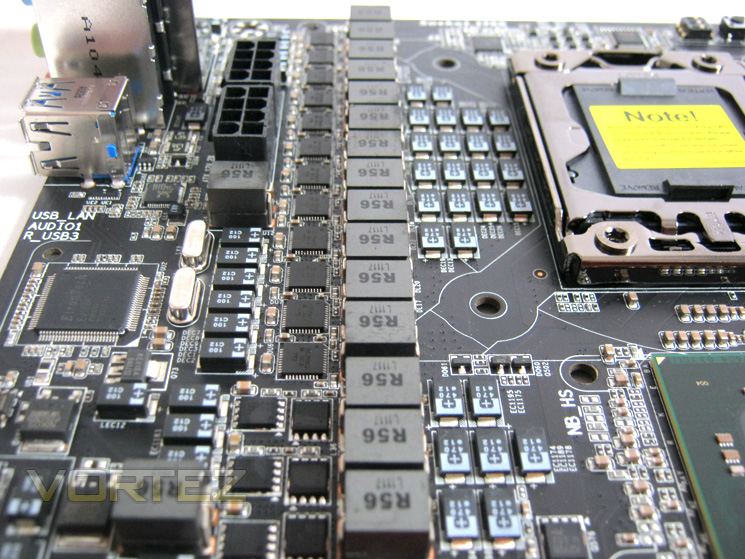
Closest to use we can see the Uncore VRM which includes Low RDS (on) MOSFETs, Inductors and POScaps. Further up the field we see the bulk of the VRM which has 12 driver MOSFETs(left), 12 chokes and 20 input capacitors (POScaps) next to the CPU socket itself. Above and below the 2x 12v inputs there are a further 10 input capacitors. Uppermost and to the left of the dipswitches, there's an iTE8275E IC which handles the phase switching in conjunction with the dip switches. Load-line calibration levels can also be adjusted thanks this little chip.
The MOSFETS used by the X58A-OC are DrMOS Gen III. SiC769CD which are rated at 35A and benefit from a 1MHz switching frequency. Because the driver is integrated on the MOSFET, efficiency is boosted to 90%. The inductors are what GIGABYTE call Max Power Ferrite Chokes (MPFC) and make up a six phase power design. Yes you read that right, 6 phase.
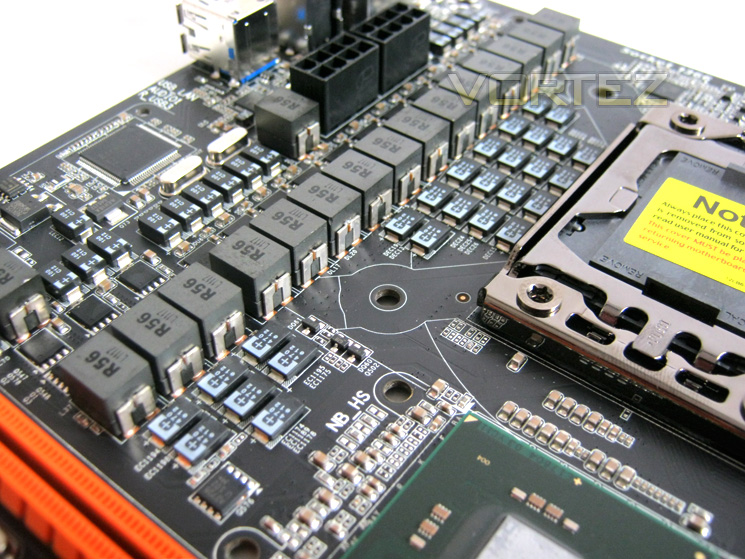
It is a common misconception that the more phases equate to better overclocking. It is not unheard of (and GIGABYTE themselves have been guilty of this) for motherboards manufacturers to enter into the 'who has the most power phases' race. The struggle to have the most phase power blinded people into believing that the more phases a motherboard had, the higher the overclocking potential when in reality, it has relatively little effect once you reach a certain threshold. to have more than triple this amount with manufacturers claiming their VRM can handle in excess of 1KW of power when in reality there is simply no need for this amount of power for the VRM alone, extreme overclocking or not. Truth be told, you will most likely struggle to use even half that. So then, GIGABYTE have therefore opted instead to invest in even higher quality components over the number of power phases. The proof, as they say, is in the pudding but I would find it hard to believe that GIGABYTE would make such a bold move were they not confident improvements were to be gleaned from incorporating this strategy.
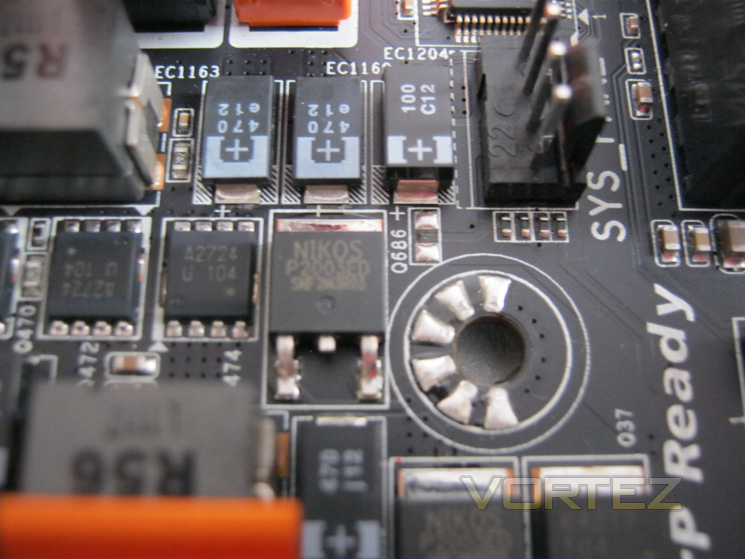
Nikos MOSFETs are also used around the motherboard to power less demanding components such as the ICH10R and SATA ports
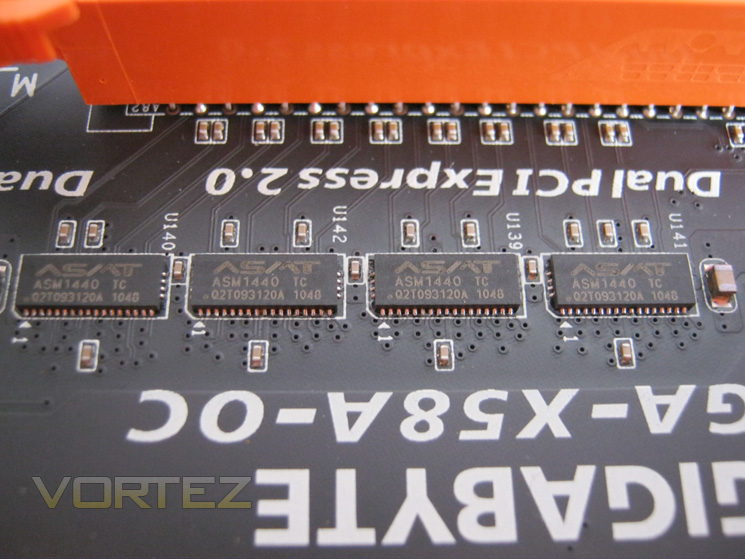
The X58A-OC is capable of 16+16 or 8x + 8x + 8x + 8x CrossfireX along with SLI/Tri SLI in 16x + 16x or 8x + 8x +8x configurations via the Tylersburg IOH. The above ASMT ASM 1440 TC PCI-E switching controllers (8 in total) afford PCIe lane switching. For optimal performance, slots 1 and 3 should be used as these are configure to be 16x. Populating the second slot will drop the top slots to 8 PCIe lanes and populating the fourth PCIe slot will also drop the third down to 8x. I would have liked to have seen the NF200 chip included but the astronomical prices NVIDIA are demanding would have sent this motherboards price spiralling out of control so its absence is understandable.
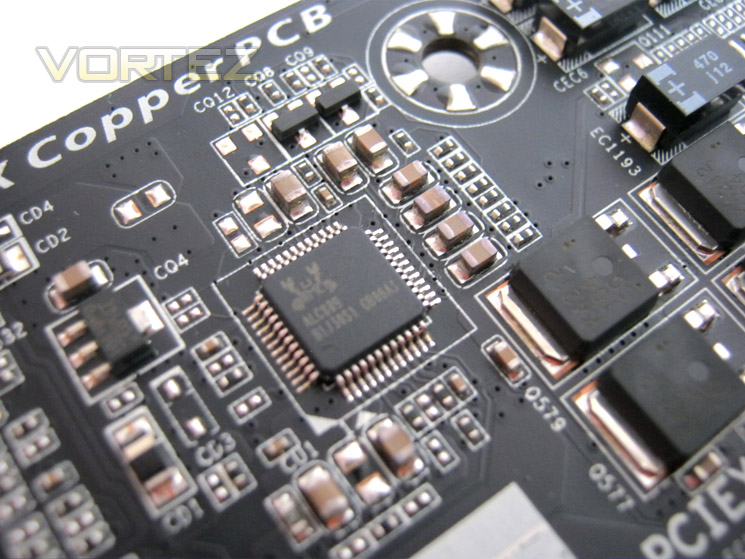
The ALC889C chip is commonplace on motherboards today provides 10 DAC channels and can potentially support 7.1 audio providing you have the required amount of outputs. 24 bit SPDIF input/output is also supported but again, this is hardly a requirement for overclocking so once more this feature has been omitted from the backplate.
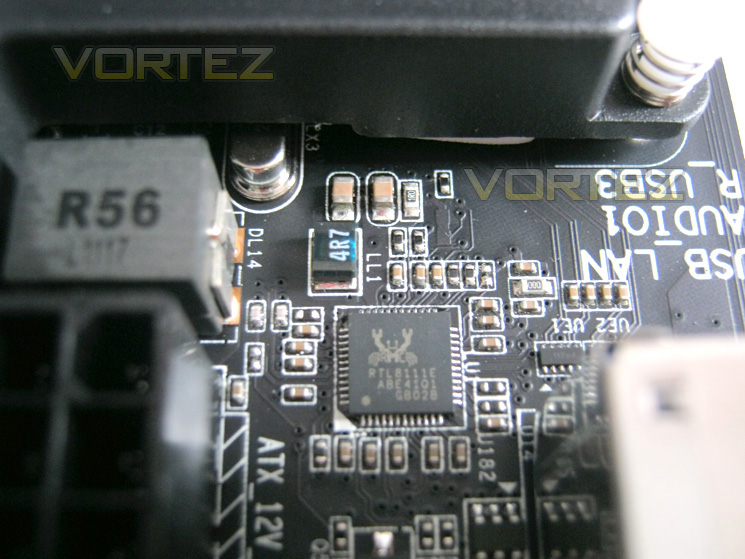
The Gigabit Ethernet controller for the X58A-OC is the Realtec RTL8111E which provides 10/100Mbps Ethernet and the IEEE 802.3ab specification for 1000Mbps Ethernet. It also supports Protocol offload by offloading some of the most common protocols to NIC hardware in order to prevent spurious wake up and to further reduce power consumption.
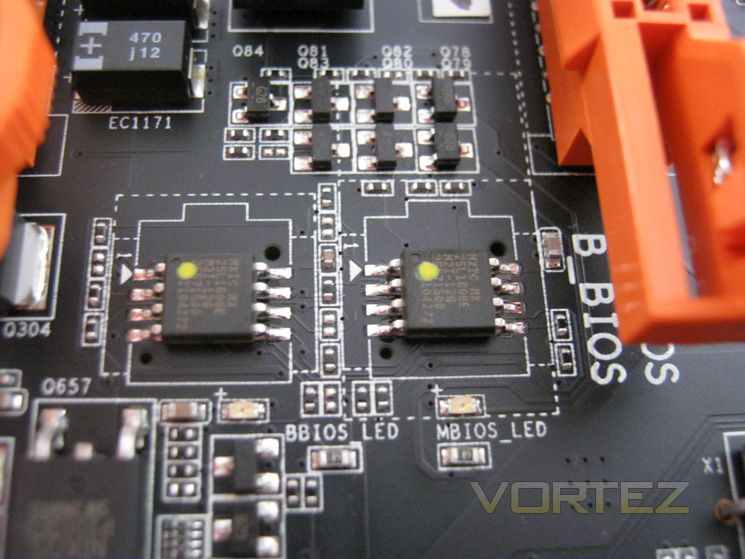
DUAL BIOS has been a feature available to GIGABYTE motherboard users for a great deal of time now so at first glance you would think this is nothing new. What is new is that users can now physically switch between BIOS revisions by the means of using an on-board switch located conveniently at the bottom corner of the motherboard. Having a Dual BIOS allows overclockers to try out different BIOS's without losing their profiles and will also allow users to simply switch to an alternative BIOS should a BIOS flashing procedure go awry.
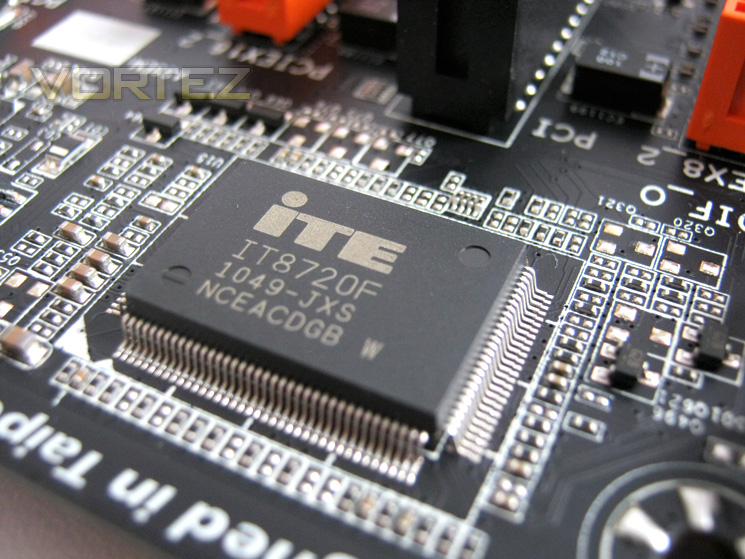
The iTE IT8720F Super I/O is a monitoring IC that monitors both CPU fan speed and control (CPU) and temperatures. The Winbond W83L786 controls the remaining 6 system fans and motherboard temperatures.
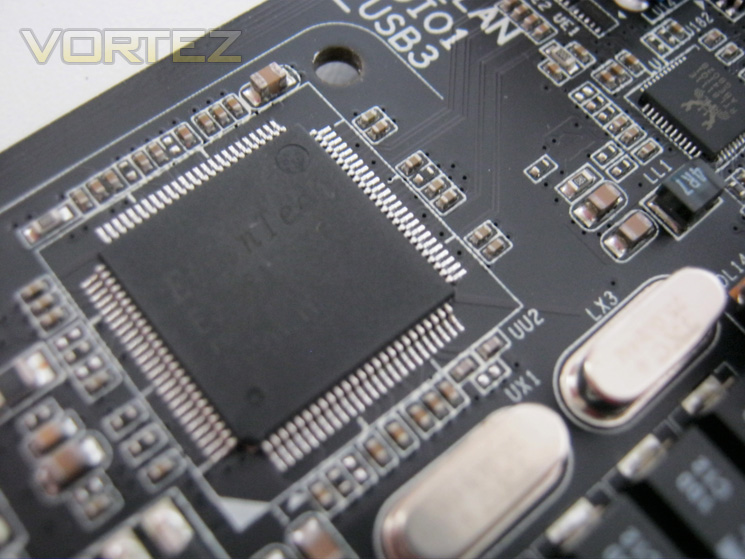
While USB 3/.0 is hardly a pre-requisite for overclocking, it is none the less a welcome addition. The EntronTech EJ168A IC controls the two USB 3.0 ports and is a relative newcomer to building system IC's with Renasus and NEC being the most commonly used controllers to date. Hopefully the EntronTech will provide more competition to the big two thereby reduce the price of integrated USB 3.0 controllers in the future.
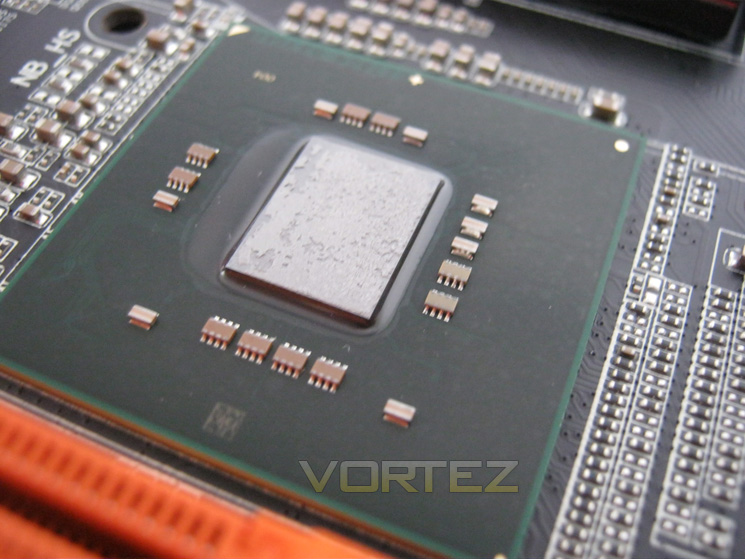
THE IOH X58 Chipset is the awesome Tylersburg unit. This piece of silicon controls all of the 36 PCIe lanes and is the main cross communication platform linking most of the on-board components together. This chip has been criticised in the past for running very hot so I was glad to see that the heatsink contact was perfect and, at least with our sample, re-application of paste would have been unnecessary.
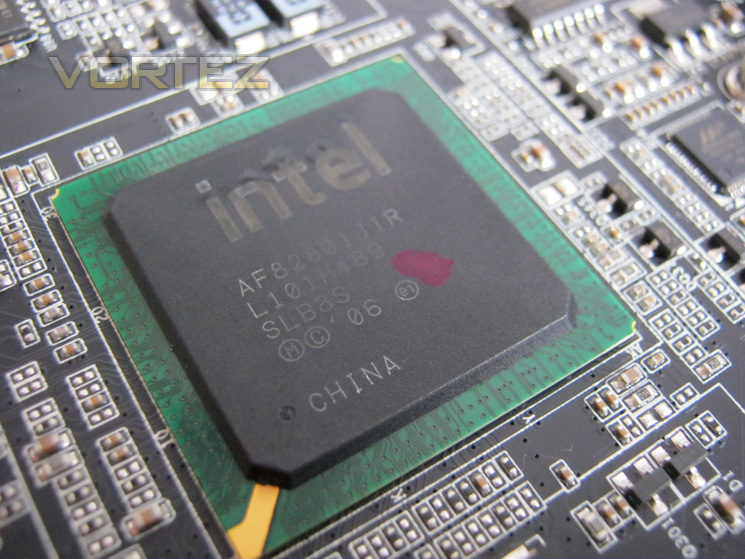
While the Intel ICH10R is obviously required for the board to function. The majority of features available to this chip are omitted from the X58A-OC as previously discussed. IT does however offer functionality to the Dual BIOS chips, the 6 SATA Ports, 4 USB 2.0 ports (2 out-board, 2 in-board), the PCI Express Bus, PCI Bus (33MHz) and communication with the Realtek Audio CODEC.
Power delivery is perhaps the single most important factor when overclocking. It is all very well having the best clocking CPU on the planet, a humongous power supply and a truck load of LN2 but if you don't have the foundation of good power delivery, all that expense will have been wasted. I am happy to report that the GIGABYTE have made some tremendous steps in ensuring this is not the case with the X58A-OC.
Voltage Regulation Module
Closest to use we can see the Uncore VRM which includes Low RDS (on) MOSFETs, Inductors and POScaps. Further up the field we see the bulk of the VRM which has 12 driver MOSFETs(left), 12 chokes and 20 input capacitors (POScaps) next to the CPU socket itself. Above and below the 2x 12v inputs there are a further 10 input capacitors. Uppermost and to the left of the dipswitches, there's an iTE8275E IC which handles the phase switching in conjunction with the dip switches. Load-line calibration levels can also be adjusted thanks this little chip.
The MOSFETS used by the X58A-OC are DrMOS Gen III. SiC769CD which are rated at 35A and benefit from a 1MHz switching frequency. Because the driver is integrated on the MOSFET, efficiency is boosted to 90%. The inductors are what GIGABYTE call Max Power Ferrite Chokes (MPFC) and make up a six phase power design. Yes you read that right, 6 phase.
Phase power
It is a common misconception that the more phases equate to better overclocking. It is not unheard of (and GIGABYTE themselves have been guilty of this) for motherboards manufacturers to enter into the 'who has the most power phases' race. The struggle to have the most phase power blinded people into believing that the more phases a motherboard had, the higher the overclocking potential when in reality, it has relatively little effect once you reach a certain threshold. to have more than triple this amount with manufacturers claiming their VRM can handle in excess of 1KW of power when in reality there is simply no need for this amount of power for the VRM alone, extreme overclocking or not. Truth be told, you will most likely struggle to use even half that. So then, GIGABYTE have therefore opted instead to invest in even higher quality components over the number of power phases. The proof, as they say, is in the pudding but I would find it hard to believe that GIGABYTE would make such a bold move were they not confident improvements were to be gleaned from incorporating this strategy.
Nikos MOSFET
Nikos MOSFETs are also used around the motherboard to power less demanding components such as the ICH10R and SATA ports
PCIe Switches
The X58A-OC is capable of 16+16 or 8x + 8x + 8x + 8x CrossfireX along with SLI/Tri SLI in 16x + 16x or 8x + 8x +8x configurations via the Tylersburg IOH. The above ASMT ASM 1440 TC PCI-E switching controllers (8 in total) afford PCIe lane switching. For optimal performance, slots 1 and 3 should be used as these are configure to be 16x. Populating the second slot will drop the top slots to 8 PCIe lanes and populating the fourth PCIe slot will also drop the third down to 8x. I would have liked to have seen the NF200 chip included but the astronomical prices NVIDIA are demanding would have sent this motherboards price spiralling out of control so its absence is understandable.
Realtek ALC889C
The ALC889C chip is commonplace on motherboards today provides 10 DAC channels and can potentially support 7.1 audio providing you have the required amount of outputs. 24 bit SPDIF input/output is also supported but again, this is hardly a requirement for overclocking so once more this feature has been omitted from the backplate.
Realtek RTL8111E LAN
The Gigabit Ethernet controller for the X58A-OC is the Realtec RTL8111E which provides 10/100Mbps Ethernet and the IEEE 802.3ab specification for 1000Mbps Ethernet. It also supports Protocol offload by offloading some of the most common protocols to NIC hardware in order to prevent spurious wake up and to further reduce power consumption.
DUAL BIOS
DUAL BIOS has been a feature available to GIGABYTE motherboard users for a great deal of time now so at first glance you would think this is nothing new. What is new is that users can now physically switch between BIOS revisions by the means of using an on-board switch located conveniently at the bottom corner of the motherboard. Having a Dual BIOS allows overclockers to try out different BIOS's without losing their profiles and will also allow users to simply switch to an alternative BIOS should a BIOS flashing procedure go awry.
iTE IT8720F
The iTE IT8720F Super I/O is a monitoring IC that monitors both CPU fan speed and control (CPU) and temperatures. The Winbond W83L786 controls the remaining 6 system fans and motherboard temperatures.
Entrontech EJ168A
While USB 3/.0 is hardly a pre-requisite for overclocking, it is none the less a welcome addition. The EntronTech EJ168A IC controls the two USB 3.0 ports and is a relative newcomer to building system IC's with Renasus and NEC being the most commonly used controllers to date. Hopefully the EntronTech will provide more competition to the big two thereby reduce the price of integrated USB 3.0 controllers in the future.
Tylersburg Intel X58 IOH
THE IOH X58 Chipset is the awesome Tylersburg unit. This piece of silicon controls all of the 36 PCIe lanes and is the main cross communication platform linking most of the on-board components together. This chip has been criticised in the past for running very hot so I was glad to see that the heatsink contact was perfect and, at least with our sample, re-application of paste would have been unnecessary.
Southbridge
While the Intel ICH10R is obviously required for the board to function. The majority of features available to this chip are omitted from the X58A-OC as previously discussed. IT does however offer functionality to the Dual BIOS chips, the 6 SATA Ports, 4 USB 2.0 ports (2 out-board, 2 in-board), the PCI Express Bus, PCI Bus (33MHz) and communication with the Realtek Audio CODEC.


