
Setup, Design & Observations
The H30 BT is quick and easy to set up using the provided accessories, the H50 BT taking a little longer because you have to strip the ends of the Hi-Fi cable of its plastic to expose the metal for the binding posts. The RCA to 3.5mm jack cables are long enough for most desktops or units to connect with your desired media device. The bluetooth connection is open and easy to pair with (even easier via NFC) and the naming of the device shouldn't cause too much confusion, I.E. H30 BT/ H50 BT. The interconnect cable is just about long enough to straddle either side of your monitor at a relatively large desk but you may need a longer one should you wish to use these with something like a 50" TV, however, in that situation, one may want to reconsider a more suitable audio solution.
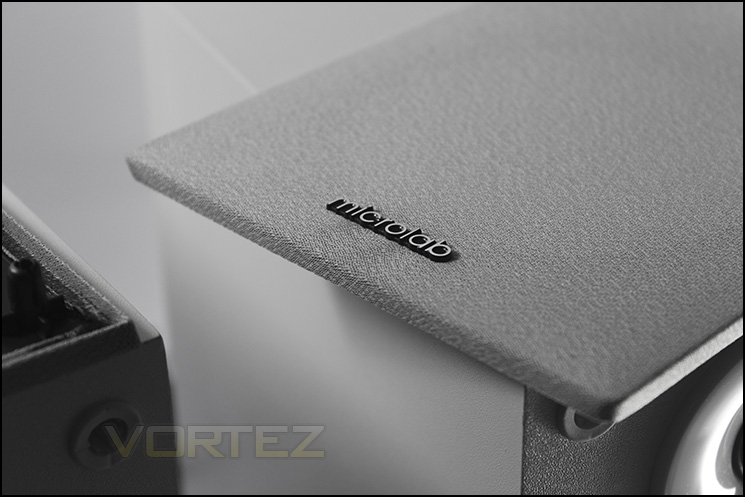
The build quality feels very strong and each unit has a fair bit of weight to it (around 2Kg each for the H30 BT and around 3.5Kg each for the H50 BT ). The finish looks and feels great, though, with enough deliberation, the coating could be knocked/torn at the edges, however Microlab appear to have used a strong waxy resin adhesive to prevent this so there should be some protection from such a thing happening.
The dials feel strong and rotate smoothly, the treble and bass dials have a tactile notch at the half way mark, so when you rotate the dial you feel it 'click' into the half way point, allowing you to feel where the dials are positioned.
Multi-Media
H30 BT
I kicked things off by using the 3.5mm jack with my aging Samsung Galaxy S2, listening through my playlist at random, I realised starting an audio test with music that uses noise and crackle as part of the actual track is not a good move, panic over, I listened through various tracks by Crystal Castles, Finntroll, Yeasayer and the volume was impressive, not more so than the sound quality. The crystal clear bass and mids accompanied by glassy treble with little to no distortion. The volume competently filled my room of 3.5 x 3.5m, not quite party level, but impressive from these relatively compact speakers. Listening through the same playlist but this time connected wirelessly, the loudness and sound quality was not noticeably different to connecting via jack.
Testing the H30 BT with the PC showed off a slight different characteristic, which to no fault of the speakers, should be considered. When used via a discrete PC sound card, in this case the Creative Sound Blaster ZxR, the speakers sounded a little more refined and professional, however, the signal was effectively 'double-amped', meaning that the loudness, hit a similar level to the max volume from the phone, when set at 50%. As the sound volume was increased beyond 50-60% (On the PC volume while speaker master volume at 100%) all that was being introduced was muddy distortion with greater loudness. This of course, is not healthy for your speakers, so, in this situation you would need to carefully consider how best to use the speakers. This should not be much of an issue for those using an integrated solution or notebook. Running at a healthy volume, I listened to various artists, watched through various videos, played a host of regular games and couldn't fault the audio quality, picking up nuances and background details clearly.
H50 BT
Running the H50 BT through the same tests as the H30 BT, it was clear that these are definitely in the next ballpark up from the H30 BT. The sound was 'bigger', more defined, the bass was deeper and smoother, while retaining that clarity in the middle and high tones. Each sound being played from whichever source, music, game or movie, felt 'separated' and distinct. The volume was impressive, certainly louder than the H30 BT, easily filling the room. The same problem was found when used with my PC sound card, again, this is a setup issue not an issue with the speakers themselves. Used correctly, these speakers will give you some impressive stereo sound regardless of your desired use.


