

Unlike the TITAN and GTX780, there are no Torx screws in sight thankfully. All the screws to remove the main cooler from the PCB are Phillips making for an easier life. To dismantle the shroud itself you will however still need an Allen key.
The cooling design comprises of a finned array welded to a nickel plated copper vapor chamber. This design is extremely efficient and because it is a fully enclosed unit, all of the hot air is pumped out of the exhaust, outside of the case at the rear. The vapor chamber is framed by the black aluminium baseplate which makes direct contact to both the memory chips and VRM areas.

Ar first glance, the design of the GTX770 is almost identical to its bigger brother, the GTX780 (bottom of above picture). There are however some key differences. The GTX780 has more memory and a slightly larger core. It also is has a different VRM design. The GTX780 has a 6+2 design while the 770 is 5+1. With this in mind, it is extremely unlikely that a GTX TITAN/780 waterblock will fit the GTX770.

The PCB itself is of course black which we like here at Vortez. Everything is where you would expect to find it with the GPU core being framed by 8 x256MB memory chips and the VRM being closest to the power inputs.

The VRM is made up of a 5+1 design as opposed to the GTX680's 4+2. The 5 main phases are dedicated to the GPU which may seem a little low for the overclockers but as we will see later in the review, this didn't seem to affect our overclocking efforts in the slightest. Interstingly, the GTX770 has a larger bank of MOSFET's than the GTX780 despite having less chokes.
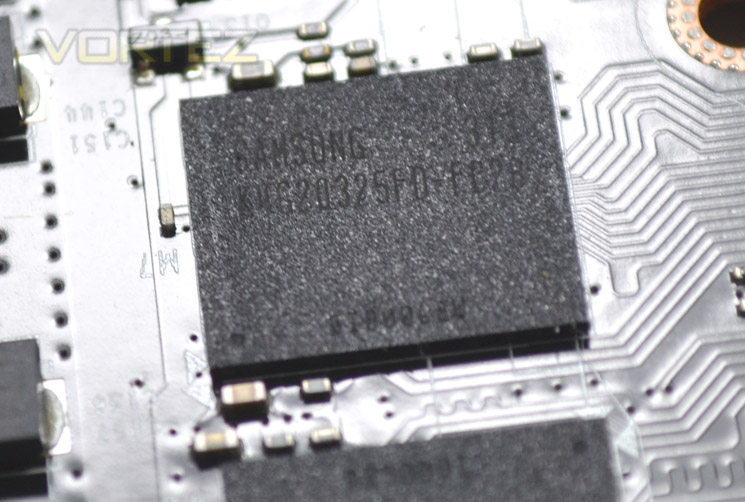
The memory IC's carry the model number K4G20325F0-FC28 and hail from Samsung. Sadly we couldn't find the official specifications of this new memory other than it is specified to run at 1.5V ± 0.045V. With NVIDIA clocking this memory to 7GBps it will be interesting to see how much is left in the tank when we come to overclock the card.

As stated previously, the core is essentially the same GK104 used in the GTX680. We would be lying if we said we were ecstatic at this choice because we were in truth a little disappointed that NVIDIA didn't opt for a trimmed down version of the flagship GK110, perhaps with just 8 SMX (the GK104 also has 8 SMX) instead of the 12 found on the GTX780. That said, the GK104 still has tremendous performance and has always been good for a little overclocking so hopefully performance will be better than that of the GTX680 while slightly off the pace of the GTX780 as you would expect.


