
First things first, the Razer Lancehead costs just shy of £140; this is a huge price when compared to perfectly useable alternatives priced around £60. This has to be considered heavily while testing the mouse, there’s absolutely no room for anything but perfection, frankly.
The laser sensor that Razer has chosen to use in the Lancehead is incredibly sensitive, so much so that dust and dirt are detected with such accuracy that it can throw the cursor way off. They have used a small Teflon curtain around the sensor to minimise any of this, along with advanced processing within the mouse to adjust for any abnormalities of this kind.
The performance of the sensor is amazing, it detects the smallest of movements when ramped all the way up to 16,000 DPI, though this is way beyond the useable range. We found the sweet spot was between 2000 and 3000, offering incredible accuracy and dependability. Battlefield 4, Paladins, Orcs Must Die: Unchained and War Thunder were the chosen games for testing.
The Razer-designed, OMROM-built switches under the right and left click feel fantastic, they’re clicky and provide plenty spring to make fast-clicking possible. Both sides feel identical, furthering the ambidextrous nature of the mouse.
The shape of the Lancehead is good, however, it is on the smaller side. Obviously, due to the ambidextrous design, it doesn’t quite have the same feel as a mouse designed for one particular hand but it does fit the 3 primary grip styles. The rubber grips on the side are good, that being said, the channels running horizontally along the mouse can encourage your fingers to move towards the back of the mouse once sweat is introduced after an intense round in-game. The scroll wheel is positioned well and features a positive click while still allowing the user to scroll long web pages without too much effort.
As always with Razer products, the build quality is class-leading. Everything feels as though it’s put together as well as it can be, with nothing considered ‘cheap’.
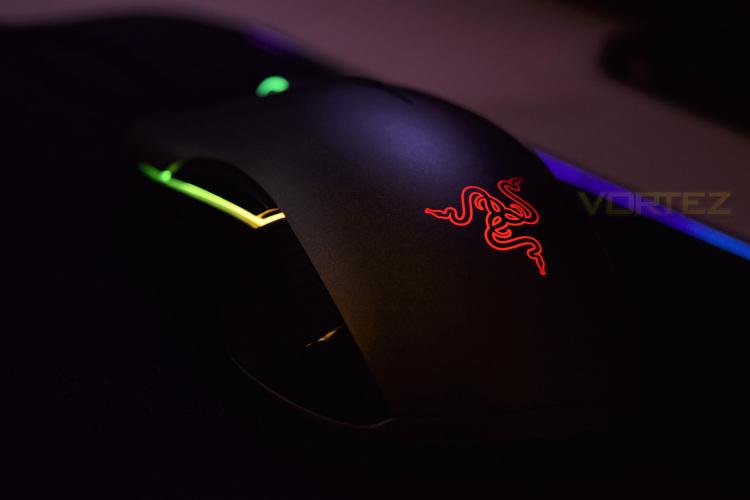
RGB lighting is a massive plus point for the Lancehead, the ability to independently control 16 different LEDs, with a range of 16,700,000 colours to choose from can create some wild effects. The Spectrum Cycling was beautiful and very vibrant on the brightest setting, battery life suffers massively in this state, however.
Razer claims that the Lancehead can last 24 hours, with RGB lighting. During our testing, we found that to be pretty much the case, getting around 22/23 hours with the RGB lighting set to one static colour and on the dimmest setting. With Spectrum Cycling active and the LEDs turned up to their brightest, the mouse lasted around 8-10 hours. The braided 2.1M cable, with unique micro-USB adaptor, makes charging very easy. With the cable being 2.1M in length, being able to tidy away some of that wire is important, though unfortunately, the included rubber cable wrap is possibly the worst we’ve seen, being stupidly fiddly to reuse – that could be much better.
Wireless performance was perfect, with absolutely no issues what-so-ever; obviously, Razer’s efforts to develop their Adaptive Frequency Technology (AFT) has paid dividends. The system scans the 2.4GHz frequency band hundreds of times per second, looking for the strongest, cleanest signal, it will then carry on using that band until it detects a stronger signal; in which case, the Lancehead then seamlessly hops over to maintain “absolute wireless supremacy”. This may not appear important in a domestic environment, where you may only be using a wireless headset and have a 2.4GHz router nearby, but in a LAN or eSports event, where hundreds of devices may be battling for bandwidth, being able to pair to the cleanest signal can win you precious milliseconds.
The laser sensor that Razer has chosen to use in the Lancehead is incredibly sensitive, so much so that dust and dirt are detected with such accuracy that it can throw the cursor way off. They have used a small Teflon curtain around the sensor to minimise any of this, along with advanced processing within the mouse to adjust for any abnormalities of this kind.
The performance of the sensor is amazing, it detects the smallest of movements when ramped all the way up to 16,000 DPI, though this is way beyond the useable range. We found the sweet spot was between 2000 and 3000, offering incredible accuracy and dependability. Battlefield 4, Paladins, Orcs Must Die: Unchained and War Thunder were the chosen games for testing.
The Razer-designed, OMROM-built switches under the right and left click feel fantastic, they’re clicky and provide plenty spring to make fast-clicking possible. Both sides feel identical, furthering the ambidextrous nature of the mouse.
The shape of the Lancehead is good, however, it is on the smaller side. Obviously, due to the ambidextrous design, it doesn’t quite have the same feel as a mouse designed for one particular hand but it does fit the 3 primary grip styles. The rubber grips on the side are good, that being said, the channels running horizontally along the mouse can encourage your fingers to move towards the back of the mouse once sweat is introduced after an intense round in-game. The scroll wheel is positioned well and features a positive click while still allowing the user to scroll long web pages without too much effort.
As always with Razer products, the build quality is class-leading. Everything feels as though it’s put together as well as it can be, with nothing considered ‘cheap’.
RGB lighting is a massive plus point for the Lancehead, the ability to independently control 16 different LEDs, with a range of 16,700,000 colours to choose from can create some wild effects. The Spectrum Cycling was beautiful and very vibrant on the brightest setting, battery life suffers massively in this state, however.
Razer claims that the Lancehead can last 24 hours, with RGB lighting. During our testing, we found that to be pretty much the case, getting around 22/23 hours with the RGB lighting set to one static colour and on the dimmest setting. With Spectrum Cycling active and the LEDs turned up to their brightest, the mouse lasted around 8-10 hours. The braided 2.1M cable, with unique micro-USB adaptor, makes charging very easy. With the cable being 2.1M in length, being able to tidy away some of that wire is important, though unfortunately, the included rubber cable wrap is possibly the worst we’ve seen, being stupidly fiddly to reuse – that could be much better.
Wireless performance was perfect, with absolutely no issues what-so-ever; obviously, Razer’s efforts to develop their Adaptive Frequency Technology (AFT) has paid dividends. The system scans the 2.4GHz frequency band hundreds of times per second, looking for the strongest, cleanest signal, it will then carry on using that band until it detects a stronger signal; in which case, the Lancehead then seamlessly hops over to maintain “absolute wireless supremacy”. This may not appear important in a domestic environment, where you may only be using a wireless headset and have a 2.4GHz router nearby, but in a LAN or eSports event, where hundreds of devices may be battling for bandwidth, being able to pair to the cleanest signal can win you precious milliseconds.


