
Testing Setup
For the Seasonic PRIME TX-1600 Noctua Edition power supply, we have upgraded our testing equipment from using a multimeter to the ElmorLabs PMD2 that monitors and measures voltage, current, and power flowing through the CPU, GPU and motherboard power cables.

Our testing methodology is still the same but we will now be using OCBase’s OCCT Enterprise Edition software for power loading and monitoring. Tweaking the OCCT Stability Test, we can set different power loads for the PSU easier rather than playing around with various software to achieve set power loads. All testing is conducted using the 230V residential power standard.

Methodology
We now have more testing points with the ElmorLabs PMD2 – two 8-pin EPS connectors (EPS1 and EPS2), three +12V 8-pin PCIE (PCIE1, PCIE2, and PCI3), and readings on the 24-pin which include +12V, +5, and +3.3. We will be monitoring and recording the voltages and wattage on each of these power cables. The PMD2 cannot monitor the +12V on the SATA/MOLEX power cables. For that, we will still be using a multimeter to also monitor the voltages delivered to the SATA/MOLEX cables.
Power load will be at 10% increments using the OCCT Stability Test running for 5 minutes – as much as our current testing setup allows which is currently 750W~800W with the following testing configuration below:
Results
Voltage readings are averaged from the 5-minute stability testing. The PRIME TX-1600 Noctua Edition utilises Seasonic’s latest design to deliver exceptionally tight voltage regulation, maintaining the +12V rail within 0.5%. In our testing, one PCIe sensor reported a 0.52% deviation; however, when factoring in the typical margin of error inherent to measurement equipment, the results align with Seasonic’s claim of Micro Tolerance Load Regulation at 0.5%. The PRIME TX-1600 Noctua Edition PSU has the best voltage regulation out of all the PSUs we've reviewed this year. Its outstanding voltage regulation is a defining trait of a flagship power supply, engineered to deliver exceptionally stable and reliable power to demanding systems. See voltage and voltage regulation tables below.
Voltages

Voltage Regulation

OCCT Stability Tests
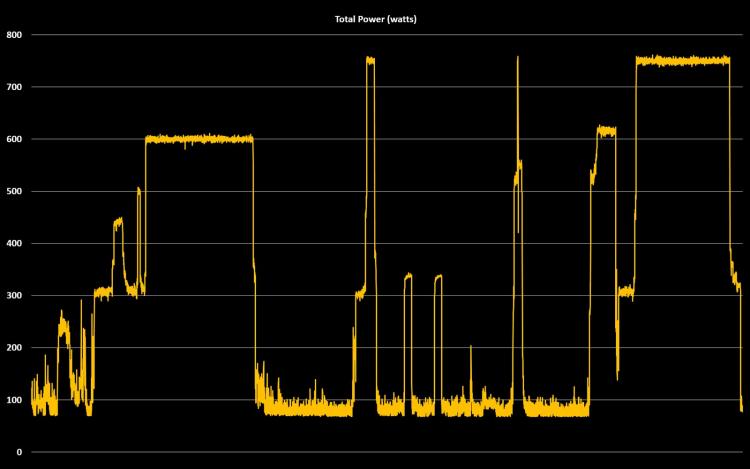
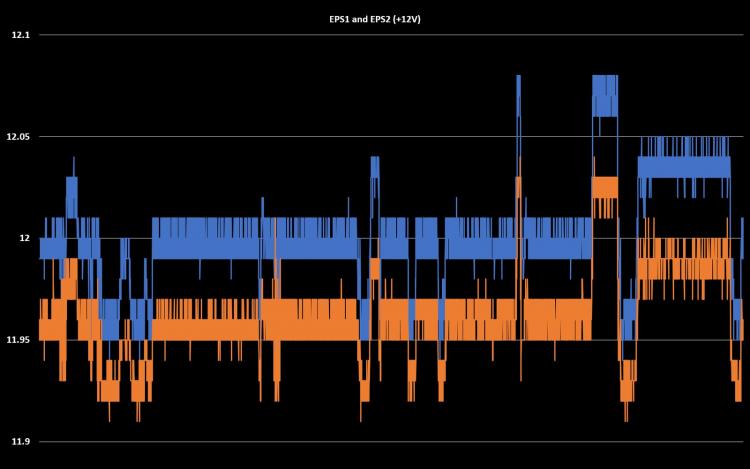
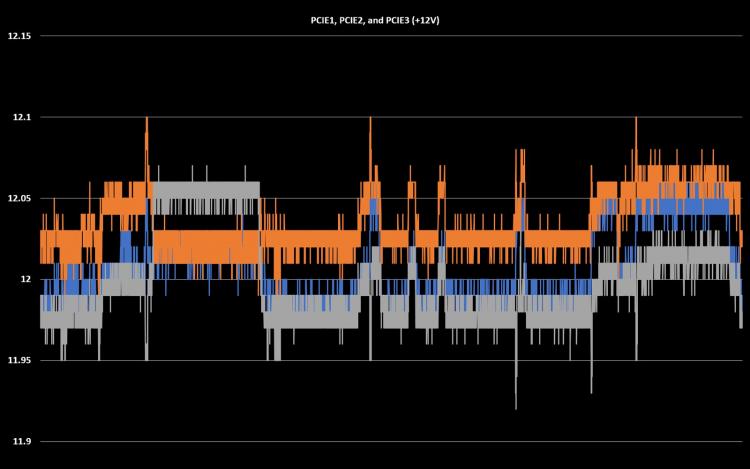
Above are the two custom stability tests with the system that aims to pull approximately 40% and 50% load on the PSU, at 600W and 750–760W respectively. Under both workload scenarios, the +12V rail remained within a 0.5% deviation. If you notice the short power load spikes recorded on the PMD2, these occurred while we adjusted the stability test parameters to dial in the exact 10% load increments. These momentary fluctuations also illustrate how the +12V rail responds to rapid changes in power load during the adjustment process.
Acoustics
This PSU attained the Cybenetics Lambda A++ noise level rating which is the highest attainable award. Equipped with the NF-A12x25 HS-PWM, our sound meter picks up around 46~47dBA when the fan is not spinning. The PRIME TX-1600 Noctua Edition features Seasonic’s hybrid cooling mode wherein the fan does not spin at low loads as shown in the photo below.
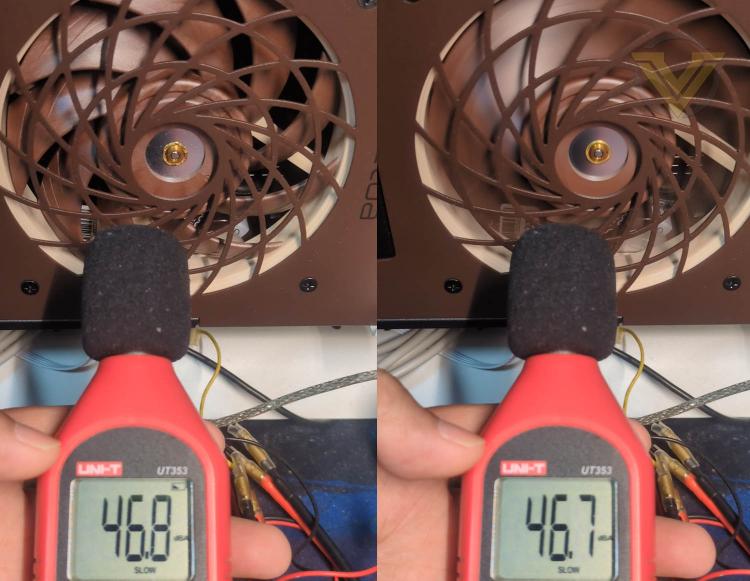
Hybrid Mode On - Left (Fan Off)/ Hybrid Mode Off (Fan Spinning),
Deactivating the hybrid cooling mode allows the fan to operate across all load scenarios while remaining PWM controlled, meaning its behaviour adjusts according to temperature and load. With hybrid mode disabled and the fan spinning, our sound meter recorded roughly the same noise level at low loads, measuring around 46 to 47 dBA. During the OCCT Stability Test, noise levels increased to 55 dBA, although this was with two graphics cards running at full workload. In summary, the PRIME TX-1600 Noctua Edition is unlikely to be a noticeable source of noise within a high performance system.
For the Seasonic PRIME TX-1600 Noctua Edition power supply, we have upgraded our testing equipment from using a multimeter to the ElmorLabs PMD2 that monitors and measures voltage, current, and power flowing through the CPU, GPU and motherboard power cables.
Our testing methodology is still the same but we will now be using OCBase’s OCCT Enterprise Edition software for power loading and monitoring. Tweaking the OCCT Stability Test, we can set different power loads for the PSU easier rather than playing around with various software to achieve set power loads. All testing is conducted using the 230V residential power standard.
We would like to thank Adrien Stevens at OCBase for providing us the software to improve our testing.
OCCT is available in various versions including Personal, Pro, Enterprise and Enterprise+. Users can avail the Personal version for free. Learn more and download OCCT at OCbase.com and on Steam.
OCCT is available in various versions including Personal, Pro, Enterprise and Enterprise+. Users can avail the Personal version for free. Learn more and download OCCT at OCbase.com and on Steam.
Methodology
We now have more testing points with the ElmorLabs PMD2 – two 8-pin EPS connectors (EPS1 and EPS2), three +12V 8-pin PCIE (PCIE1, PCIE2, and PCI3), and readings on the 24-pin which include +12V, +5, and +3.3. We will be monitoring and recording the voltages and wattage on each of these power cables. The PMD2 cannot monitor the +12V on the SATA/MOLEX power cables. For that, we will still be using a multimeter to also monitor the voltages delivered to the SATA/MOLEX cables.
Power load will be at 10% increments using the OCCT Stability Test running for 5 minutes – as much as our current testing setup allows which is currently 750W~800W with the following testing configuration below:
CPU: Intel Core i7-13700K (5.3GHz)
Cooling: Noctua NH-D15 G2
Motherboard: GIGABYTE Z790 AORUS EXTREME X
Graphics Card: GIGABYTE GeForce RTX 3070 EAGLE OC / COLORFUL iGame GeForce RTX 4060 Ti
Memory: ADATA XPG Lancer DDR5-8000 32GB Kit
Storage: ADATA Legend 960 Max 1TB / 2TB Seagate SkyHawk 5900 RPM
Cooling: Noctua NH-D15 G2
Motherboard: GIGABYTE Z790 AORUS EXTREME X
Graphics Card: GIGABYTE GeForce RTX 3070 EAGLE OC / COLORFUL iGame GeForce RTX 4060 Ti
Memory: ADATA XPG Lancer DDR5-8000 32GB Kit
Storage: ADATA Legend 960 Max 1TB / 2TB Seagate SkyHawk 5900 RPM
Results
Voltage readings are averaged from the 5-minute stability testing. The PRIME TX-1600 Noctua Edition utilises Seasonic’s latest design to deliver exceptionally tight voltage regulation, maintaining the +12V rail within 0.5%. In our testing, one PCIe sensor reported a 0.52% deviation; however, when factoring in the typical margin of error inherent to measurement equipment, the results align with Seasonic’s claim of Micro Tolerance Load Regulation at 0.5%. The PRIME TX-1600 Noctua Edition PSU has the best voltage regulation out of all the PSUs we've reviewed this year. Its outstanding voltage regulation is a defining trait of a flagship power supply, engineered to deliver exceptionally stable and reliable power to demanding systems. See voltage and voltage regulation tables below.
Voltages
Voltage Regulation
OCCT Stability Tests
Above are the two custom stability tests with the system that aims to pull approximately 40% and 50% load on the PSU, at 600W and 750–760W respectively. Under both workload scenarios, the +12V rail remained within a 0.5% deviation. If you notice the short power load spikes recorded on the PMD2, these occurred while we adjusted the stability test parameters to dial in the exact 10% load increments. These momentary fluctuations also illustrate how the +12V rail responds to rapid changes in power load during the adjustment process.
Acoustics
This PSU attained the Cybenetics Lambda A++ noise level rating which is the highest attainable award. Equipped with the NF-A12x25 HS-PWM, our sound meter picks up around 46~47dBA when the fan is not spinning. The PRIME TX-1600 Noctua Edition features Seasonic’s hybrid cooling mode wherein the fan does not spin at low loads as shown in the photo below.
Hybrid Mode On - Left (Fan Off)/ Hybrid Mode Off (Fan Spinning),
Deactivating the hybrid cooling mode allows the fan to operate across all load scenarios while remaining PWM controlled, meaning its behaviour adjusts according to temperature and load. With hybrid mode disabled and the fan spinning, our sound meter recorded roughly the same noise level at low loads, measuring around 46 to 47 dBA. During the OCCT Stability Test, noise levels increased to 55 dBA, although this was with two graphics cards running at full workload. In summary, the PRIME TX-1600 Noctua Edition is unlikely to be a noticeable source of noise within a high performance system.


