
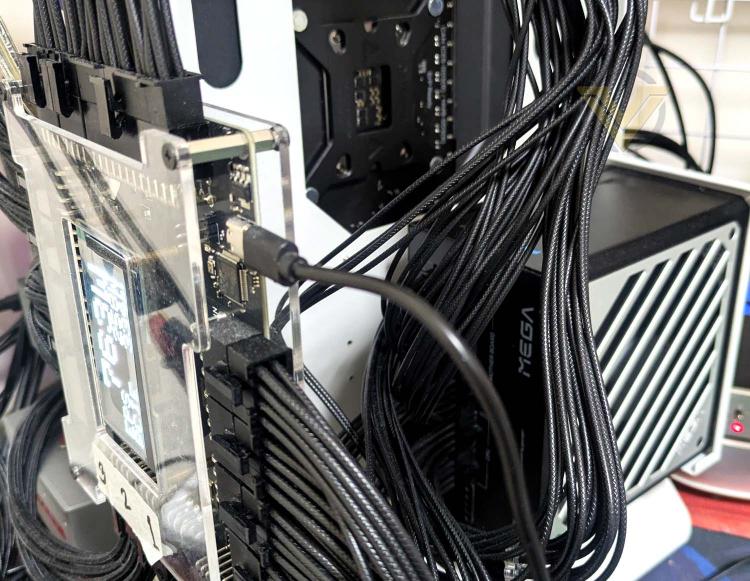
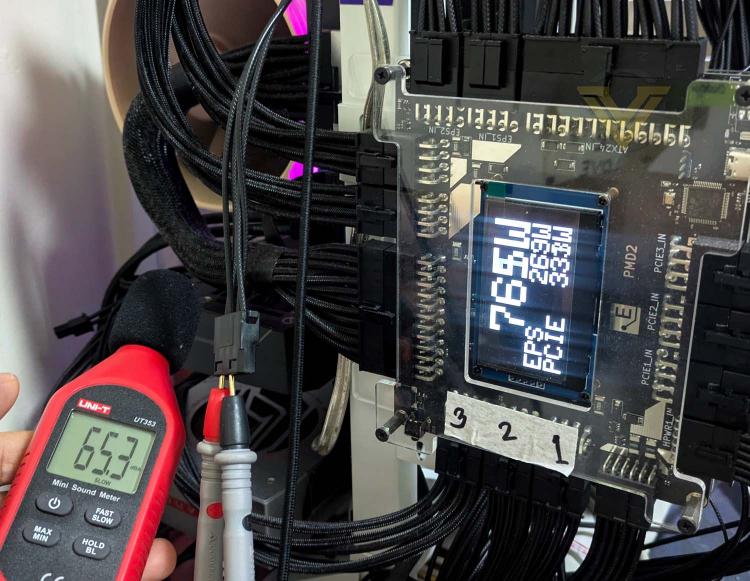
We will be using an ElmorLabs PMD2 that monitors and measures voltage, current, and power flowing through the CPU, GPU and motherboard power cables.
Our testing methodology will now be using OCBase’s OCCT Enterprise Edition software for power loading and monitoring. Tweaking the OCCT Stability Test, we can set different power loads for the PSU easier rather than playing around with various software to achieve set power loads. All testing is conducted using the 230V residential power standard.

Methodology
The ElmorLabs PMD2 features several monitoring points which includes two 8-pin EPS connectors (EPS1 and EPS2), three +12V 8-pin PCIE (PCIE1, PCIE2, and PCI3), one 12V-2x6 connector (HPWR) and readings on the 24-pin which include +12V, +5, and +3.3. For the +12V output on the peripheral/molex cable, we will be using a multimeter.
Not all of the PCIE connectors are populated with a device thus have barely any load on them. Still, they are connector to the PMD2 device and is still monitored and recorded throughout the tests. The graphics cards are plugged into the corresponding connectors below.
HPWR (12V-2x6): GeForce RTX 3070
PCIE 1: Unused
PCIE 2: Unused
PCIE 3: GeForce RTX 4060 Ti
While I have not given emphasis on how the PCIE connectors are populated in previous reviews, this appears to be relevant to this particular PSU when it comes to the load balancing the MEGA GM does with powered devices.
Like all the previous PSU reviews, power load will be at 10% increments using the OCCT Stability Test running for 5 minutes – as much as our current testing setup allows which is currently 750W~800W with the following testing configuration below:
Results
Voltage
Voltage Regulation
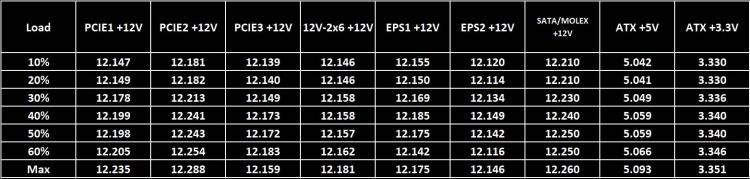
With our test configuration, system load peaked at 802W with an average of 770W during the maximum load test which is achieved by running CINEBENCH 2024 – CPU (Multi Core) stress test and OCCT’s Power – Stability Test simultaneously. We have observed a unique load balancing characteristic on the MEGA GM 1000 that’s unlike other PSUs we’ve tested.
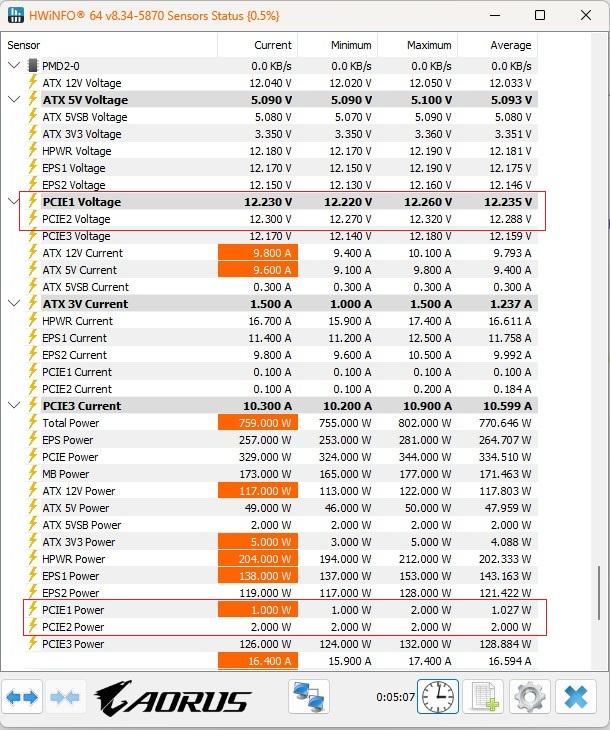
Based on our results, the MEGA GM 1000 demonstrates tighter +12V regulation on loaded rails compared to unpopulated ones, as illustrated in the table and monitoring screenshot above where PCIE1 and PCIE2 carry no load. This indicates that the PSU’s regulation is optimised for active load conditions rather than idle outputs. Let's discuss this further in the graphs below
Power Load Tests and Graphs
The graphs below show the 60% load and maximum load statistics. At two spikes at the beginning show the power spikes upon opening CINEBENCH 2024 then the OCCT software.
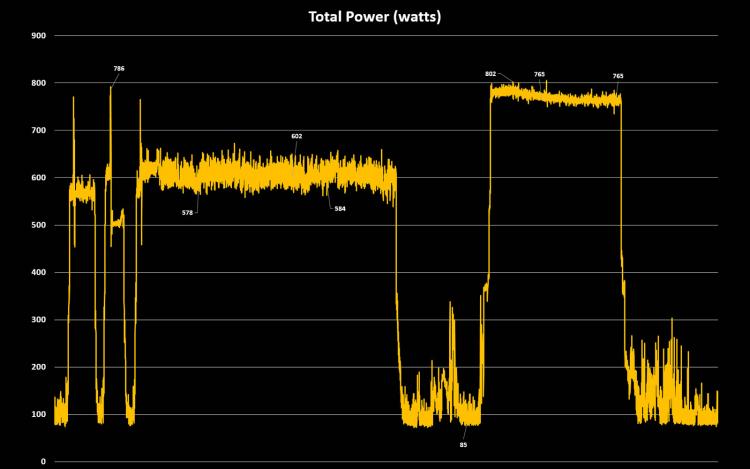
In all load scenarios, the MEGA GM’s +12V readings across all connectors remained above 12.00V, indicating very tight voltage regulation with a slight positive voltage bias. This is a favourable characteristic, as it promotes stable power delivery while compensating for cable and connector losses under load.
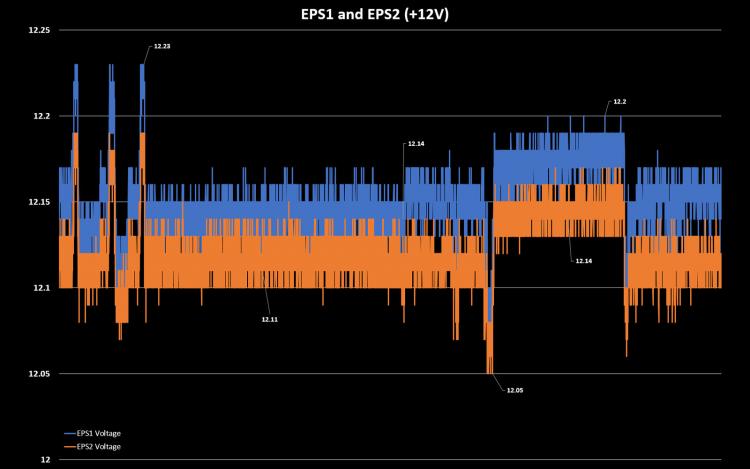
EPS readings at 60% and maximum load highlight the strength of the FSP MEGA GM 1000’s +12V rail, with its slight positive voltage bias ensuring levels never dropped below 12.00V even under heavy load. In comparison, we observed +12V readings falling below 12.00V on some connectors at loads above 50% on units such as the MONTECH BETA 2 850W and SAMA B850, both of which use pigtail EPS connectors, as well as the ENERMAX REVOLUTION III S 1000W despite utilising dedicated EPS cables per connector.
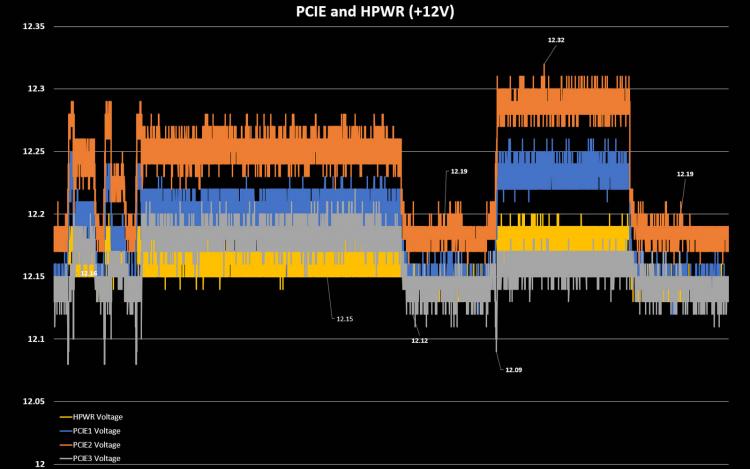
A similar trend is observed on the +12V rails supplying the PCIe and 12V-2x6 connectors, where voltages consistently remained above 12.00V. As noted earlier, loaded PCIe connectors exhibit tighter voltage regulation compared to those with little to no load — more apparent when separating results between connectors powering the graphics card and those connected only to the PMD2 for monitoring (graphs below). This behaviour reflects the PSU’s regulation tuning, where voltage is maintained more precisely under actual load conditions.
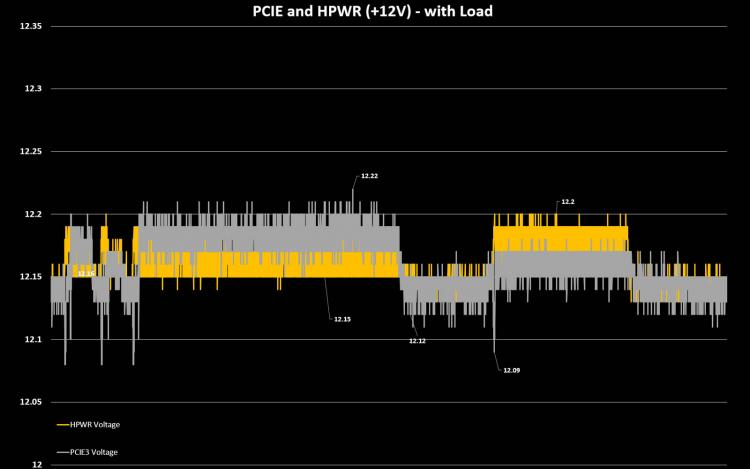
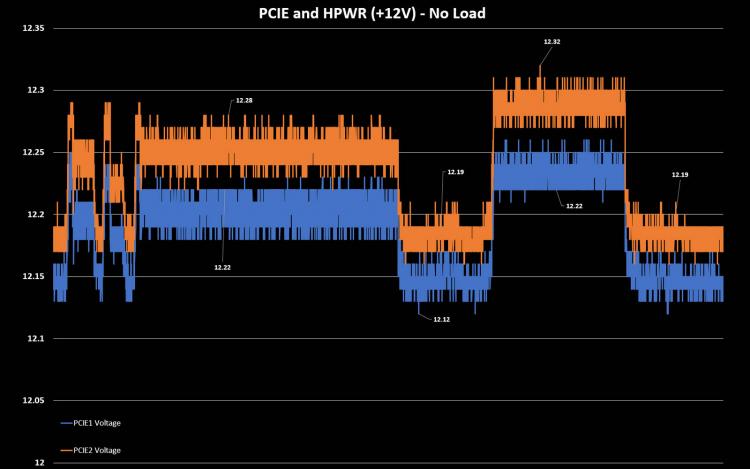
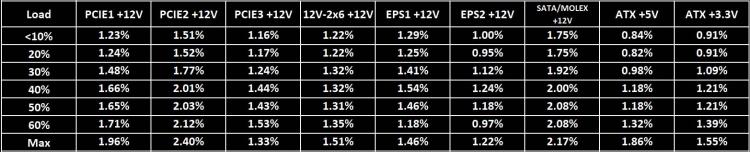
Overall, the MEGA GM 1000 delivers tight +12V regulation of less than or equal to 1.5% across EPS, PCIe, and 12V-2x6 connectors, ensuring stable power delivery to critical components such as the motherboard, CPU, and graphics card.
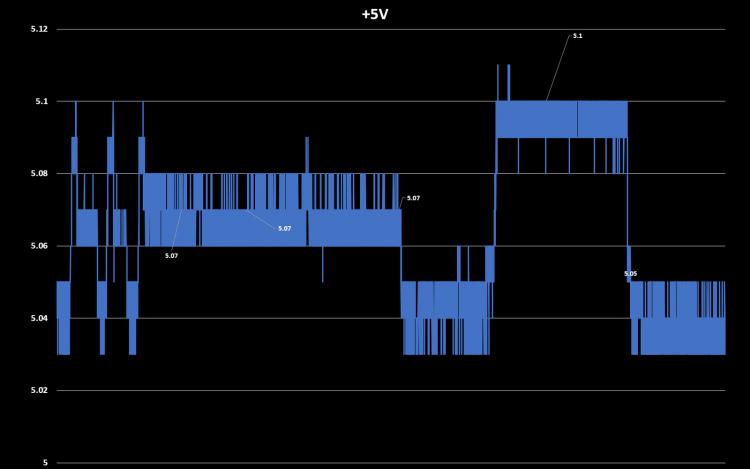
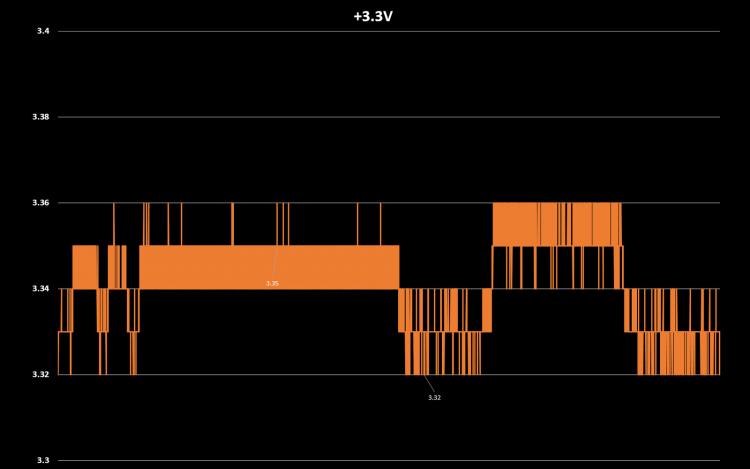
The positive voltage bias is also evident on the +5V and +3.3V rails across all load scenarios. The only rail showing slightly looser regulation is the +12V line on the MOLEX/SATA cables, with variance of around 2%. This is not unusual, as these peripheral cables are typically lower priority in PSU design and often use thinner wires, longer cable runs, and fewer sense points compared to EPS and PCIe cables. As a result, they are more susceptible to minor voltage drop and less aggressive regulation tuning, especially since they do not power highly sensitive or high-current components.
Acoustics
The FSP MEGA GM 1000 features an Eco semi-fanless mode, controlled via a switch at the rear of the PSU, allowing users to enable or disable passive operation. When enabled, the unit remains silent under low loads, with fan activation governed by internal temperature. In cooler environments, this allows the PSU to operate passively for extended periods.
Under higher loads, the Power Logic PLA13525S12M 135mm fan remains notably quiet. During our maximum load testing, noise measurements taken near the PSU were approximately 5 dBA lower than readings recorded near the CPU cooler and graphics card. For reference, ambient noise in our test environment measured 45 dBA with the system powered off, indicating that the PSU contributes minimally to overall system noise even under heavy load.
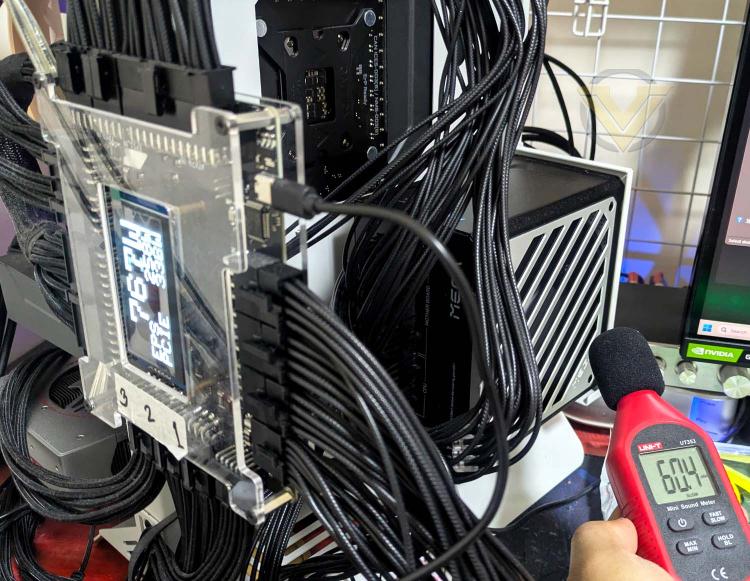
Lastly, there was no coil whine observed from our sample unit throughout the testing and actual usage.
Our testing methodology will now be using OCBase’s OCCT Enterprise Edition software for power loading and monitoring. Tweaking the OCCT Stability Test, we can set different power loads for the PSU easier rather than playing around with various software to achieve set power loads. All testing is conducted using the 230V residential power standard.
Methodology
The ElmorLabs PMD2 features several monitoring points which includes two 8-pin EPS connectors (EPS1 and EPS2), three +12V 8-pin PCIE (PCIE1, PCIE2, and PCI3), one 12V-2x6 connector (HPWR) and readings on the 24-pin which include +12V, +5, and +3.3. For the +12V output on the peripheral/molex cable, we will be using a multimeter.
Not all of the PCIE connectors are populated with a device thus have barely any load on them. Still, they are connector to the PMD2 device and is still monitored and recorded throughout the tests. The graphics cards are plugged into the corresponding connectors below.
HPWR (12V-2x6): GeForce RTX 3070
PCIE 1: Unused
PCIE 2: Unused
PCIE 3: GeForce RTX 4060 Ti
While I have not given emphasis on how the PCIE connectors are populated in previous reviews, this appears to be relevant to this particular PSU when it comes to the load balancing the MEGA GM does with powered devices.
Like all the previous PSU reviews, power load will be at 10% increments using the OCCT Stability Test running for 5 minutes – as much as our current testing setup allows which is currently 750W~800W with the following testing configuration below:
CPU: Intel Core i7-13700K (5.3GHz)
Cooling: Noctua NH-D15 G2
Motherboard: GIGABYTE Z790 AORUS EXTREME X
Graphics Card: GIGABYTE GeForce RTX 3070 EAGLE OC / COLORFUL iGame GeForce RTX 4060 Ti
Memory: ADATA XPG Lancer DDR5-8000 32GB Kit
Storage: ADATA Legend 960 Max 1TB / 2TB Seagate SkyHawk 5900 RPM
Room Temperature: ~24°C
Average Room Noise Level: ~45 dBA (test PC off)
Cooling: Noctua NH-D15 G2
Motherboard: GIGABYTE Z790 AORUS EXTREME X
Graphics Card: GIGABYTE GeForce RTX 3070 EAGLE OC / COLORFUL iGame GeForce RTX 4060 Ti
Memory: ADATA XPG Lancer DDR5-8000 32GB Kit
Storage: ADATA Legend 960 Max 1TB / 2TB Seagate SkyHawk 5900 RPM
Room Temperature: ~24°C
Average Room Noise Level: ~45 dBA (test PC off)
Results
Voltage
Voltage Regulation
With our test configuration, system load peaked at 802W with an average of 770W during the maximum load test which is achieved by running CINEBENCH 2024 – CPU (Multi Core) stress test and OCCT’s Power – Stability Test simultaneously. We have observed a unique load balancing characteristic on the MEGA GM 1000 that’s unlike other PSUs we’ve tested.
Based on our results, the MEGA GM 1000 demonstrates tighter +12V regulation on loaded rails compared to unpopulated ones, as illustrated in the table and monitoring screenshot above where PCIE1 and PCIE2 carry no load. This indicates that the PSU’s regulation is optimised for active load conditions rather than idle outputs. Let's discuss this further in the graphs below
Power Load Tests and Graphs
The graphs below show the 60% load and maximum load statistics. At two spikes at the beginning show the power spikes upon opening CINEBENCH 2024 then the OCCT software.
In all load scenarios, the MEGA GM’s +12V readings across all connectors remained above 12.00V, indicating very tight voltage regulation with a slight positive voltage bias. This is a favourable characteristic, as it promotes stable power delivery while compensating for cable and connector losses under load.
EPS readings at 60% and maximum load highlight the strength of the FSP MEGA GM 1000’s +12V rail, with its slight positive voltage bias ensuring levels never dropped below 12.00V even under heavy load. In comparison, we observed +12V readings falling below 12.00V on some connectors at loads above 50% on units such as the MONTECH BETA 2 850W and SAMA B850, both of which use pigtail EPS connectors, as well as the ENERMAX REVOLUTION III S 1000W despite utilising dedicated EPS cables per connector.
A similar trend is observed on the +12V rails supplying the PCIe and 12V-2x6 connectors, where voltages consistently remained above 12.00V. As noted earlier, loaded PCIe connectors exhibit tighter voltage regulation compared to those with little to no load — more apparent when separating results between connectors powering the graphics card and those connected only to the PMD2 for monitoring (graphs below). This behaviour reflects the PSU’s regulation tuning, where voltage is maintained more precisely under actual load conditions.
Overall, the MEGA GM 1000 delivers tight +12V regulation of less than or equal to 1.5% across EPS, PCIe, and 12V-2x6 connectors, ensuring stable power delivery to critical components such as the motherboard, CPU, and graphics card.
The positive voltage bias is also evident on the +5V and +3.3V rails across all load scenarios. The only rail showing slightly looser regulation is the +12V line on the MOLEX/SATA cables, with variance of around 2%. This is not unusual, as these peripheral cables are typically lower priority in PSU design and often use thinner wires, longer cable runs, and fewer sense points compared to EPS and PCIe cables. As a result, they are more susceptible to minor voltage drop and less aggressive regulation tuning, especially since they do not power highly sensitive or high-current components.
Acoustics
The FSP MEGA GM 1000 features an Eco semi-fanless mode, controlled via a switch at the rear of the PSU, allowing users to enable or disable passive operation. When enabled, the unit remains silent under low loads, with fan activation governed by internal temperature. In cooler environments, this allows the PSU to operate passively for extended periods.
Under higher loads, the Power Logic PLA13525S12M 135mm fan remains notably quiet. During our maximum load testing, noise measurements taken near the PSU were approximately 5 dBA lower than readings recorded near the CPU cooler and graphics card. For reference, ambient noise in our test environment measured 45 dBA with the system powered off, indicating that the PSU contributes minimally to overall system noise even under heavy load.
Lastly, there was no coil whine observed from our sample unit throughout the testing and actual usage.


